Chair Succession: A CHAIRS Global Intelligence Brief

Summary and Preamble (If These Can Even Coexist)
You don’t get to read your own Eulogy. It’s not your succession. But you already knew that. It’s the board’s and increasingly the organisation’s succession. The model of Chair that you have so admirably delivered in your tenure has worked so well. Like an Irish wake, it’s now a chance to prepare to celebrate the closure of that era not mourn its end. Time to ready for letting go but doing that with grace and legacy.
One thing is certain of every Chair succession we have supported in the recent era internationally, and that is the model of Chair that got the board successful is so rarely the model that will keep it successful. But while the new Chair will have a thorough due diligence of what the Chair needs to now stop doing and start doing for the era ahead, there must be a conscious awareness and commitment to what they must continue doing, the real DNA transfer that explains legacy.
For two decades, boards have professionalised CEO succession. They have turned it into a multi-year strategic discipline with structured evaluation, leadership development, scenario planning and stakeholder transparency. Yet the most powerful role in the boardroom, the Chair, remains governed by an informal, opaque, personality-driven process that belongs to a different era. This asymmetry has become untenable. Chair succession is now the most dangerous unplanned leadership vacancy in the modern corporation.
We only need to look in headline news of any economic jurisdiction to see the headline of disappointment and shame associated with the appointment, conduct, performance or just the role of the Chair. But then again, will we ever see again a news headline that reads “Chair of Board does great Job!”
The Chair is no longer a ceremonial steward. They are the sentinel of the board’s Conformance, the cheerleader for its Performance, the role model of its Conscience, and the anchor of its Character. When the Chair is mis-cast, the board loses its ability to diagnose executive failure, navigate crises, manage CEO transitions or maintain legitimacy with investors. A weak Chair does not merely underperform; they destabilise the organisation’s entire governance system.
Current Chair succession practices, late conversations, heir-apparent politics, inward-looking assessments, minimal external calibration and no developmental pipeline, are structurally inadequate for this era of scrutiny, activism and complexity. Many boards still default to elevating former CEOs into the Chair’s role, even as investors and regulators challenge the dilution of independence and the erosion of oversight. A process that would be unacceptable for selecting a CEO continues to be tolerated for appointing the person responsible for supervising the CEO.
This paper proposes a fundamental reframing: Chair succession must evolve into a continuous, deliberate, future-oriented process. It must begin with a clear appreciation of the tasks of the next Chair, not the biography of the outgoing one. It must build an internal pipeline, expose emerging Chairs to real governance challenges, incorporate external market mapping, and use structured evidence to support high-consequence decisions. It must treat the transition itself as a designed event, not a polite handover.
Boards that make this shift will enjoy an immediate and compounding advantage. They will strengthen CEO oversight, lift strategic clarity, deepen cultural integrity, and reduce friction with investors, regulators and activists. They will widen and diversify the pool of legitimate future Chairs. Most importantly, they will demonstrate that they hold themselves to the same standards of renewal, accountability and transparency they demand from management.
The question facing every board is disarmingly simple: if the Chair were gone tomorrow, what evidence could we show that we are prepared, today, to appoint an even better one?
Few boards can answer confidently. That is the challenge. And the opportunity.
The Wisdom of the Chairs Crowd
Of the succession processes for Chairs we have supported around the world in the recent era, the following have been lifted from director debrief interviews of the processes as a snapshot of user opinions and nuggets of learned wisdom:
“We’ve done Chair ‘replacement’ too often: that short cut determined by whose turn it is, who does the current Chair most prefer or who is the most senior or perceived most competent. A game of chance really.”
“This isn’t your succession Chairs, it is your Board’s. You might get a vote but don’t over influence your preference. You might be the least qualified to know what is needed next!”
“The next Chair won’t be, can’t be, shouldn’t be like you were as Chair. The leadership that got your Board successfully to this point is rarely going to be the leadership it needs to get to the next point.”
“Be careful to test what unspoken messages and signals you will be making by your selected new Chair being appointed. The message of appointing a lawyer, a turnaround expert, a former international CEO?”
“Find the right and required balance of those four forces living in the Chair’s head: their attention or subordination to Conformance, Performance, their Conscience and their own Character.”
“Define with the whole Board, the Chair that the future Board needs and compare everyone to that and never to each other. Don’t use meeting exciting candidates as the guide for what you are looking for.”
“You are not simply choosing a person. You are choosing the future state and dynamic of the Board and the faith and trust in that Board internally and externally.”
“Selecting a new Chair will determine a higher variance in future risk and performance of the organisation than any merger or acquisition you will do. We invest months and millions in the due diligence of such a merger. We have no excuse not to for a succession then.”
“Being selected as Chair is a choice to serve, not an achievement that needs serving. Intent and motive of a new Chair is more important than their track record of commercial performance.”
“No one is ever going to scrutinise the CV or peruse the detailed Role Profile of your chosen new Chair. It’s got to be in the headline. You have to ask ‘what message are we sending everyone by making this appointment?’”
Rethinking and Re-Engineering Chairman Succession
Chair succession is the last unmodernised frontier of corporate governance. For two decades boards, regulators and advisers have poured energy into professionalising CEO succession. It has become a mature discipline, complete with scenario modelling, leadership diagnostics, stakeholder engagement strategies, transition orchestration and long-horizon development programmes. Your own CHAIRS Global architecture reflects this evolution: a systematic enquiry beginning with the “why” rather than the “who,” and ending with a richer conception of success conditions rather than a name in a press release.
Chair succession, by contrast, remains still a strangely artisanal craft. It is still treated as a quiet ritual rather than a strategic inflection point. Board leadership is handed from one generation to the next through informal conversations, legacy loyalties, implicit seniority and tacit political choreography.
Even today, boards that would never dream of choosing a CEO without rigorous external benchmarking, independent assessment and a structured multi-year process will routinely choose their next Chair with none of these safeguards in place.
Some boards still default to the notorious shortcut of elevating the outgoing CEO into the Chair’s seat, even as investors and proxy advisers loudly protest that such a move collapses independence and weakens oversight.
The consequence of this immaturity is increasingly visible. In an era of complex risk, heightened stakeholder scrutiny and public demands for ethical corporate leadership, the Chair has quietly become one of the single greatest systemic leverage points in organisational resilience. A mis-cast CEO can be replaced. A weak Chair can paralyse the board’s ability to diagnose the very failures it is responsible for preventing. Chair succession is therefore not only overdue for reform; it is becoming a governance obligation whose neglect will be punished by markets, regulators and society.
This paper offers an ambitious reframing: that Chair succession is now more important than CEO succession, that its current model is inadequate, and that a radical transition to a continuous, strategic and transparent system is both possible and necessary and already being adopted by many diligent and conscientious Boards around the world. Done properly, Chair succession will lift board performance, stabilise CEO selection, strengthen stakeholder trust, calm activist pressure and ultimately improve long-term corporate value.
Why Chair Succession Now Matters More Than Traditional Processes Honour
The Chair’s influence has changed shape. Once the custodian of an orderly boardroom, the modern Chair is expected to be strategist, coach, referee, conscience, ambassador, risk sentinel and cultural architect. They must orchestrate the board’s Conformance duties in an environment of proliferating regulation, while enabling Performance through strategy, innovation and executive accountability. They must embody Conscience in an era of environmental, social and ethical scrutiny, and anchor Character amidst volatile internal and external pressures. When this role is mis-filled, the board drifts, the CEO relationship fractures, strategic decision-making warps and the organisation’s moral centre weakens.
Several global forces now make Chair succession more consequential than ever. Stakeholders, from regulators to shareholder activists, have increased expectations of independent board leadership, and are scrutinising the Chair’s legitimacy, process of appointment and ongoing independence. The independent Chair is still a relatively young institution in many markets, and boards have not yet built the muscle memory required to transition leadership gracefully. Research repeatedly notes that while boards talk about succession, only a minority maintain formal, multi-candidate succession plans for their board leaders. Even basic conditions for renewal, such as term limits for directors, remain rare. The absence of structured renewal at the board leadership level leaves Chair succession dangerously exposed to personality, politics and passive drift.
The greatest irony is that Chair succession remains underdeveloped precisely because Chairs are powerful. Many sitting Chairs control their own succession conversations, consciously or unconsciously discouraging discussion that might be interpreted as disloyal or destabilising. Yet this silence creates fragility. The role entrusted with managing CEO succession has no equivalent system to manage its own successor. In governance terms, this is structural hypocrisy.
In a world where governance quality is now directly linked to valuation, culture and risk outcomes, this situation is untenable. Chair succession must move from background ritual to continuous governance discipline.
Why Chair Succession Is Different From CEO Succession
Boards cannot simply replicate the CEO succession process and apply it to the Chair. But we will be negligent not to learn from the process methodologies of the most successful CEO successions. The role has its own distinctive psychology, power dynamics and stakeholder architecture. While CEO succession is anchored in operational capability, commercial insight and leadership of the executive system, Chair succession centres on the board as a social, relational and decision-making organism. The Chair’s primary arena is not the business but the board itself, the system that oversees the business.
Unlike CEOs, Chairs operate almost entirely through influence rather than authority. Their impact is conversational, agenda-setting, tone-defining, boundary-holding and values-anchoring. Their failures are subtle, slow to reveal themselves, and more damaging when they do. Moreover, the candidate pool for Chair roles is dramatically narrower than for CEO roles, as few executives have ever trained in “board leadership” as a craft. Without deliberate development, the pipeline defaults to seniority, tenure or past executive glory. More importantly, the Chair Role Profile is almost always under-specified. Boards that would create detailed CEO specifications often rely on generic templates or legacy descriptions for the Chair. This means boards evaluate candidates against imagined expectations rather than explicit, future-oriented tasks and conditions. Investor-facing leadership expectations have also evolved dramatically, yet many Chair appointments still follow processes designed decades ago.
These differences make the traditional “tap-on-the-shoulder” approach dangerous. Without a deliberate, transparent, evidence-based structure, Chair succession too often becomes an exercise in legacy perpetuation or organisational politics rather than governance excellence.
The Anatomy of Today’s Outdated Chair Successions
Stakeholders expect evidence for the selection of a Chair. As companies like BP are now experiencing, get it wrong and that appointment can have a significant share price attributed to it specifically. Gone are the honourable days of awaiting white smoke to come from the roof of the Boardroom. This is a risk due diligence in the eyes of those relying on the protection and oversight of that Chair. As our old mathematics teachers used to write against bold answers, boards need to show their working!
Across jurisdictions, industries and governance models, the same patterns of weakness repeat themselves. Chair succession discussions typically begin too late, often triggered by an impending retirement, a health issue or external pressure, rather than as part of the board’s annual governance rhythm. The incumbent Chair often controls or heavily shapes the conversation, consciously or not, limiting genuine contestability. Heir-apparent politics emerge, with deputy chairs or long-tenured directors treated as inevitable successors, regardless of actual fit or future needs.
Too often there is no refreshed Chair Role Profile that reflects the organisation’s strategy, stakeholder pressures, leadership demands or risk horizon for the coming 3 to 5 years. Boards sometimes simply reuse outdated descriptions, failing to articulate what the next Chair must do and enable. External benchmarking is uncommon, despite the fact that Chair appointments have reputational, regulatory and market implications. Without independent scrutiny or structured referencing, the board risks self-referential decision-making.
Potential Chair successors frequently lack deliberate development. They may chair committees or lead occasional board conversations, but are rarely exposed to the full complexity of governance leadership: investor confrontations, activist campaigns, regulatory crises, CEO breakdowns, culture scandals or strategy deadlocks. Without real-world scenarios, the board cannot meaningfully assess readiness.
This opacity extends to markets and investors. Stakeholders are generally given no insight into how the new Chair was chosen, what alternatives were considered or what governance rationale underpins the choice. As a result, Chair succession processes are increasingly challenged by proxy advisers, activists and sophisticated governance analysts. A process that would be deemed unacceptable for CEO succession is still tolerated, barely, for Chairs. This fragile, informal, personality-driven system is no longer defensible.
A New Model: Chair Succession as a Due Diligence Not a Project
Chair succession must evolve into a continuous, strategic system embedded in the board’s architecture and annual rhythm. The core principle is that succession planning begins with defining the tasks, not the candidates.
The process begins with defining the need, the purpose and intent. A Chair succession risk assessment, testing resilience under, perhaps, sudden vacancy, activist pressure, regulatory interruption or CEO failure, brings objectivity to a conversation often clouded by collegial politeness and face-saving.
The next evolution is defining the work of the next Chair. This requires a task-anchored, time-bound, stakeholder-tested Chair Role Profile derived from the board’s future landscape of Conformance, Performance, Conscience and Character. A Chair leading a decarbonisation pivot requires different task mastery than one stewarding a regulatory inquiry or executing global expansion. Stakeholders, including major investors and regulators, increasingly expect boards to articulate these expectations explicitly.
A deliberate internal pipeline is essential. Boards should identify plausible Chair successors well in advance and expose them to complex, Chair-grade experiences: leading sensitive investigations, managing external crises, orchestrating major strategy conversations, handling dissent and navigating high-stakes investor dialogues. Development becomes intentional rather than accidental, similar to the advanced CEO-candidate syllabus that relies on real situations, relationships and structured coaching. Chair succession becomes a long-term developmental journey, not a last-minute political choice.
External perspective adds rigour. Mapping the external Chair and lead-director market prevents insularity, strengthens the internal decision and signals seriousness to stakeholders. Clear policies for when and how a former CEO may become Chair, cooling-off periods, independence safeguards, shareholder consultation, help maintain legitimacy in an area now under intense public scrutiny. External advisers support but do not substitute for board judgement.
The selection decision itself demands a disciplined governance process. Boards should rely on structured evidence packs, behavioural observation over time, calibrated referencing and a formal decision architecture designed to minimise bias. This mirrors the modern CEO selection logic: achieving confidence in the quality of the decision rather than certainty about the future.
Finally, the transition must be designed with the same seriousness as the appointment. Planned overlap, explicit expectations for the outgoing Chair’s role, a structured first-year plan for the incoming Chair and early feedback loops ensure stability, continuity and momentum. The moment of transition becomes not a polite handover but a deliberate uplift in board effectiveness.
Towards a Disclosable and Effective Best Practice for Success
Looking back at numerous celebrated processes by boards as well as celebrated outcomes, there is a clearly apparent pattern to how the most effective have adopted discipline, structure and the right environment in order to ensure success. It’s recognisable as 6 rational steps:
Step 1: Anticipating the Need. We can’t leave the planning trigger for Chair Succession to the imminent arrival of a calendar event, the presumption of tenure or the nod from the current Chair. Recent successions have been triggered by such a spectrum of long expected or reactive events: the inevitable tenure of a Chair achieved and not renewed; the demands of shareholders or activists; behaviour, performance, sickness and death; conflict or a message-sending resignation.
Between current Chair and Chair of the Nominations Committee or its equivalent, there needs to be an ongoing anticipation and regular rehearsal of such transition discussions. The best boards treating Chair Succession as they do CEO Succession: the presumption of an elegant transition in time, balanced by readiness for more rapid change.
Step 2: Define the Process. Defining and aligning on a clear process for a future succession should be the easiest and least controversial or debated factor of all. Boards are increasingly building such process into either the definitions of the Board or Committee Charters or as a ready ‘sealed envelope’ in their evolving standard operating procedures. Typically, such a process design adopts the 6 Steps articulated in this paper with allocation of accountabilities and more contingent factors.
These include most often the definition of what constitutes a majority vote, the role and vote of the existing Chair and Executive Directors and CEO and an evolving frame for the Chair Role Profile. Will there be a Succession special or sub-committee? Policies on disclosure and reporting? Etc.
Step 3: Design and Align on The Role. The most troubled and ineffective processes see boards rely on meeting the bench of proposed internal and/or external candidates, laced with a memory of the characteristics of the current Chair, as a means to determine what they are seeking at the point of selection. This too often leads to a fractured or split Board at the moment it needs to be most aligned. Best Boards report that the most time that they spent in the entire process was in this Step.
The right Role Profile is built not for replacing the Chair but for true succession, taking into account the required evolution of the role against the tasks, not characteristics, that progress in the planned strategic path ahead for the Board. Many seek the inclusion and voice of stakeholders beyond the Board, increasingly the input of key shareholders, executives and even regulators and strategic customers. Recruiting inclusion early creates ownership and awareness of the process rather than leaving a future announcement to chance acceptance at that point.
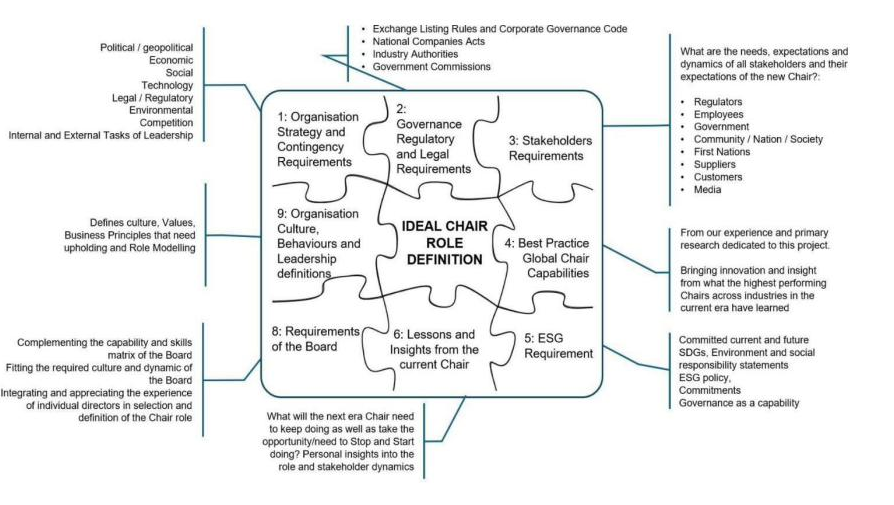
Step 3 Expanded, Defining the Role, the Design Inputs
Defining the Role Profile for a new era of Chair has been likened by Boards to as being the most valuable clarifier for organisation direction after a full Board and Management Strategy Day. This isn’t about evolving a list of capabilities, experiences and characteristics as if some caricature of the right candidate. This is the due diligence that seeks to exhaust an aligned appreciation of the future scenarios, opportunities and threats, of the organisation and therefore the required tasks for the Board succeeding in delivering that era, and only then asking what the ideal capabilities, experiences and behaviours would best lead and deliver those tasks. The illustration below offers the fullest appreciation of input and influence to a Board determining that need accurately and in a way that can be explained:
Step 4: Identifying, Confirming and Supporting Candidates. Who are and where are the next Chair candidates? Akin to a CEO Succession, a Board needs to have a very well explained reason if the intent is to seek an external appointment straight into a new Board as Chair. The messaging is too inviting of judgement: Was no one ready? Did no one want the role, why? What undeclared leadership gap is this compensating for? What impact will new leadership have on the harmony and trust in the current Board (or are you appointing an external on the strict instruction of don’t change anything?) If the need for an external to lead the Board for a new era was envisaged, then the time for that talent introduction might have more elegantly been to arrive as a new Board member 1 to 3 years earlier.
Nonetheless, there is also the timely and critical signalling of an external Chair being appointed straight in. Perhaps off the back of a major new strategic direction, an unfavourable judgement of the Board by media, shareholders or regulators. Or, as recent experience reveals, a well orchestrated Chair succession where the new Chair is suddenly conflicted or has a life or health event precluding their continuance.
For the existing Board we cannot presume that the ‘obvious’ or popular candidates should or will put their hands up. Chairs share with us that a type 1 fear is that the ideal or preferred candidates on their Board don’t put up their hands. Worse still, the inevitable type 2 fear is that the least attractive or ‘appointable’ candidates do put up their hands! How do we handle that!
A thorough and truthfully prepared Role Profile being shared with the Board should have the effect of discouraging those who can see that they do not meet the profile on experience, behaviour or reputation, and encourages those whose humility might have needed that encouragement. Using the Role Profile to judge future ideal candidates not pre-judge existing Board members.
Directors should be invited to consider their own profile against the Chair ideal Role Profile and that this triggers nothing more than a private discussion with the Chair and/or the appointment advisers to the Board (more on this later) to determine their qualification for the process toward selection ahead.
One of the only strict rules of a successful succession process must be that no director is a candidate or presumed to be a candidate until they declare that they are; that they are afforded as much time and support as necessary to consider that bold decision, and in doing so we mitigate the likelihood of an unsuccessful candidate feeling shame or even rejection by their own Board.
For the candidates consciously to elect to proceed to selection, no matter how seasoned and confident they may be, it is essential that they are provided support to prepare themselves to put their very best feet forward. Too often we have seen a final selection day won by the candidate best able to sell and promote their experience and qualification. Balancing the presentations playing field is critical to making the right selection decision.
Step 5: Selection and Decision Making. As with most processes, it’s easiest to structure this phase as Before, During and After. The During is most seen as a formal candidate presentation and selection day. A date in the diary that all steps in the process are designed backwards from. More on that final decision day later. The Before comprises selection activities designed to bring as much ‘level playing field’ data and evidence to that day.
Most processes will comprise candidates preparing and submitting a formal manifesto to director for pre-reading, how they appreciate the needs of the ongoing organisation, the key objectives of the Board and their qualification and intent for delivering on these. Classically a CV or written references might be supplied. Increasingly, advisers to a Board on the process may conduct confidential reference soundings with all directors to capture feedback on the perceived pros and cons and selection considerations of each standing candidate (being so careful of course not to trigger a premature or influenced pre-selection decision). Ongoing support to candidate preparation for the presentation day continues in the lead up.
Back to the During phase: A typical selection day is not in the established company boardroom. Offsite minimises distractions, witnesses, the presence of well-meaning but unhelpful supporters for candidates and spies. The Board begins with reminding itself of why it is here and what it is solving for, its rules of engagement to ensure the day doesn’t slip into a popularity pageant at any stage. We won’t go into the detail of the sequence and structure of what has worked to best shape the run of the day but that’s the arena of a supporting paper for Chairs on the topic.
No matter how much science process and data emerging, the day inevitably ends in an around the room expression of findings, evidence and decision. Some Chairs have invited their Board to sleep on the decision. We have found those Chairs suggesting not to based on their experience, the outcome being directors diverging their thinking not converging, and a reversion to perceptions, judgement, beliefs and evidence on candidates from before the process.
Step 6: Communications and Transitions. A well-considered internal and external communications plan will have been developed and considered as part of the process design phase of the programme, our Step 2. How the process has been communicated to stakeholders, especially candidates, up front has been seen as a critical stabilising success factor. The same goes for external stability and support, indeed praise, for the Board formally announcing the successful candidate.
What are we going to announce? When are we going to announce it? How are we going to announce it? Careful factors to ensure a successful process is as successfully received. There are, of course, patterns observable that give us clues and insights as to how best let the world know about the new choice and why they were chosen. The parameters and purpose of this paper though preclude us taking more detailed space so do get in touch and we can share those examples.
Supporting the transition of the outgoing Chair to the next? We haven’t supported a new Chair who hasn’t confessed to becoming splendidly consciously incompetent after their first year in the new role. It’s healthy, as long as it’s recognised and acted upon. All successful candidates to Chair were appointed with apparent resolvable gaps in their profile. Such support can strongly mitigate this. Transition support to the new Chair can comprise mentoring by other external Chairs as well as formal mentoring and coaching as required. It’s an increasingly common part of the process and not a shaming of under qualification. Worth considering, if not factoring into the risk assessment of the appointment from the outset.
The Impact of Doing Chair Succession Better
When Chair succession is executed with the seriousness it deserves, transformation follows. Boards become sharper, more confident and more cohesive. The Chair-CEO relationship stabilises because both leaders operate with clarity, mutual accountability and defined boundaries. Investor trust increases as the board can articulate and defend its leadership logic. Activist campaigns lose leverage when leadership succession is clearly grounded in independence, competence and future-readiness. Diversity at the top of the board increases, as deliberate succession planning widens the aperture beyond traditional candidates and legacy power structures.
Most importantly, Chair succession becomes an expression of the board’s conscience. It reflects whether the board holds itself to the same standards of transparency, merit and accountability that it demands from management. It becomes a test of institutional integrity: whether the board is prepared to plan its own renewal with the same discipline it applies to the organisation it governs.
Ultimately, Chair succession shapes the board’s culture. A board that approaches its own leadership with foresight, humility and system thinking sends a clear signal to management, regulators, markets and society that it is a learning organism, not a static hierarchy. In an age where governance is synonymous with trust, this cultural signal is invaluable.
Beyond confidence and trust, there appears to be emerging a more powerful manifestation of providing stakeholders the evidence that a Board is about to be very well led. We recognise it as what we call ‘The Governance Premium’, that tangible influence to analysts and shareholders that provides faith and unwritten assurances that the promises of a new Strategy, guidance or forecast, are more likely to be achieved. A priceless valuation on a leadership appointment.
A Provocation to Today’s Chairs
If the Chair’s role is to ensure the organisation always has a better CEO than the one it has today, then the Chair must confront a parallel obligation: to ensure the board will always have a better Chair than the one it has today. The uncomfortable truth is that many boards could not confidently answer the simplest succession question: If the Chair were gone tomorrow, what evidence exists that the board is ready, right now, to appoint an even stronger successor? Most boards would blush. That is the provocation.
CEO succession has matured. Chair succession is now following suit across jurisdictions. The Boards that modernise Chair succession first will enjoy a governance advantage that compounds quietly over years: sharper decision-making, stronger culture, calmer crises, higher investor and executive trust and more resilient organisational performance. Chair succession is not a ceremonial footnote. It is the next great project in de-risking governance, elevating leadership and strengthening the strategic spine of modern organisations.
A Postscript
We had better stop here and ensure this paper was readable over one cup of tea or the taxi between the airport and the Board meeting. Of course, there are so many topics to add to this discussion and we want to draw attention to these here to ensure users don’t feel we have missed critical pieces in the Chair Succession Jigsaw. Companion papers to this explore the following equally essential considerations that have been raised and answered by Chairs in recent succession processes for our clients:
- What does define a successful Chair if it is premature to just celebrate a great appointment?
- How must we handle internal and external candidates that can be better supported and prepared as candidates before, during and after the process. Especially those unsuccessful?
- Should we not adopt a Chair Succession risk register? The consequence and planning for loss of a trusted Chair and the actions on turbulence post appointment?
- What should be the role of the Senior Independent Director or Deputy Chair? What if they intend to present as a candidate?
- How should the final decision be made? With what data, weighting, evidence? With what definition of majority? The role of the current Chair, abstaining, casting, equal vote?
- The CEO’s role in the process?
- Chair Succession as a tool of whole Board renewal and design or as a vacancy replacement?
- Actions on triggering events for an Emergency Succession?
- Development, transition and support to the new Chair in their first year?
For now let’s come back to the basics. Not who we want but what the Board and the Organisation needs for this next, changing era of governance for the enterprise. As one Chair put it recently and importantly:
“Let’s see if we can leave personalities out of the equation for as long as we can shall we?”
Annex 1: What Do the Lawyers and Regulators Require of a Chair Succession?
Across the major governance jurisdictions of Australia, New Zealand, the United Kingdom and the United States, one theme is consistent: none of the regulatory frameworks or listing rules explicitly prescribe a detailed succession process for the Chair of the Board.
Instead, the regulation of Chair succession is addressed indirectly through a lattice of expectations about independence, separation of powers between the Chair and CEO, orderly board renewal, tenure limitations and disclosure requirements. The result is a conspicuous gap. The absence of any mandated, explicit Chair succession framework is particularly evident in Australia and New Zealand, where regulators have recently criticised boards for failing to maintain documented or credible Chair succession plans. It is in this regulatory silence that the governance risk becomes most acute.
Australia
In Australia, the ASX Corporate Governance Principles and Recommendations provide the central guidance. These Principles operate on an “if not, why not” basis and expect boards to structure themselves to add value, with Principle 2 setting the tone for modern board leadership. Recommendation 2.2 states that the Chair should be an independent director, while Recommendation 2.3 discourages the same individual from holding both the Chair and CEO roles. It further suggests that former CEOs should not transition immediately into the Chair role, noting that a minimum three-year gap is needed before independence can even be considered. Recommendation 2.4 requires boards to maintain a nomination committee, explicitly tasking it with responsibility for “board succession planning generally.”
Beyond the ASX, the Australian Institute of Company Directors reinforces the expectation that boards must plan proactively for orderly succession and renewal, warning of the destabilising impact of abrupt transitions, particularly in the roles of CEO and Chair. Recent consultation processes for the shelved fifth edition of the ASX Principles saw investors, governance bodies and legal organisations advocating for stronger language that would require overlap in director, chair and committee chair succession, as well as contingency planning for unanticipated departures. Despite this pressure, regulatory requirements still stop short of creating a Chair-specific succession mandate, and ASX practice continues to evolve as a matter of expectation rather than rule.
New Zealand
New Zealand exhibits similar patterns. The NZX Corporate Governance Code, operating on a “comply or explain” basis, recommends that the Chair be independent and that the Chair and CEO roles be separated. The Code’s recent amendments emphasise that the Chair must be independent not only in a formal sense, but also in relation to the CEO. It highlights the importance of boards disclosing their overall succession planning arrangements, particularly where directors have served long tenures. The Financial Markets Authority’s Corporate Governance Handbook reinforces the Chair’s pivotal role as a bridge between the board and the CEO, underscoring that independence and clear role demarcation are essential. It advises boards to use skill and capability matrices and to report annually on Board composition, renewal and succession.
Yet the most revealing insight comes from the 2023 RBNZ/FMA Governance Thematic Review, which found that, in all supervised entities examined, none had a clear or documented Chair succession plan. The review concluded that succession planning was generally weak, even though most chairs identified it as a priority. This explicit regulatory criticism highlights how significant the gap has become and strengthens the argument that Chair succession planning is one of the last unaddressed governance vulnerabilities in the New Zealand system.
UK
In the United Kingdom, the regulatory approach is more developed but still indirect. The UK Corporate Governance Code, updated in 2018 and further refined in 2024, operates on a comply-or-explain basis but sets clear expectations. The Chair must be independent on appointment, and Provision 19 establishes that no Chair should remain in post for more than nine years from their first appointment to the board, creating a real and visible “succession clock.” Boards must also have “plans in place for orderly succession” for both the board and senior management. The Financial Reporting Council’s Guidance on Board Effectiveness elaborates on these expectations, stating that the Senior Independent Director should often take primary responsibility for leading an orderly Chair succession process in partnership with the nomination committee.
Market examples illustrate how closely investors monitor this area. Cases such as Marks & Spencer’s extension of Archie Norman’s tenure beyond the nine-year guideline show that deviations are possible, but only with clearly articulated rationale and intensive investor engagement. While the Code does not impose a detailed Chair succession process, the combination of tenure expectations, independence requirements and investor scrutiny effectively forces UK boards to plan Chair succession earlier and more explicitly than in other jurisdictions.
USA
By contrast, the United States maintains the greatest flexibility. There is no national governance code, and regulatory requirements arise from a blend of exchange listing standards, SEC disclosure rules and state corporate law. NYSE and Nasdaq rules require a majority-independent board and independent key committees but do not mandate an independent Chair or require separation between the Chair and CEO roles. SEC rules emphasise disclosure of governance arrangements rather than prescribing their structure. As a result, the real pressure in the US comes not from regulators but from proxy advisers and large institutional investors, many of whom increasingly favour independent board leadership, either through an independent Chair or a powerful Lead Independent Director.
Trends reported by Glass Lewis and similar bodies show a gradual increase in the prevalence of independent Chairs. Many large US corporations articulate expectations around board leadership succession in their own corporate governance guidelines, often assigning the nominating or governance committee responsibility for succession planning, but these arrangements remain bespoke and vary widely by company. The absence of any regulatory prescription makes the US a fertile environment for boards seeking to adopt higher standards voluntarily, and therefore an ideal jurisdiction for the introduction of a Chair Succession Framework that goes beyond minimum compliance.
Taken together, the cross-jurisdictional picture reveals a systemic gap. All regimes emphasise orderly board succession, renewal and independence, yet almost none specifically require Chair succession planning. Several, particularly Australia and New Zealand, have now publicly highlighted the absence of documented Chair succession processes in practice. Regulators in all jurisdictions are steadily increasing expectations around disclosure of governance arrangements, board composition, independence assessments and renewal processes. That expanding disclosure space creates a natural opportunity for boards to articulate and formalise a Chair Succession Framework that includes a clear role profile, defined process ownership (often by the SID or nomination committee), internal pipeline development, external benchmarking and structured transition planning. Across all jurisdictions, Chair succession is emerging as a governance responsibility whose absence is increasingly visible, and increasingly indefensible.
Bibliography and References
| Category | Source/Title | Organisation/Author | URL |
|---|---|---|---|
| Regulatory Codes, Australia (ASX) | ASX Corporate Governance Principles & Recommendations (4th Edition) | ASX Corporate Governance Council | https://www.asx.com.au/documents/regulation/cgc-principles-and-recommendations-fourth-edn.pdf |
| ASX Consultation Feedback on Governance Principles (2023 to 2024) | ASX / Public submissions | https://www.asx.com.au/regulation/consultation | |
| Law Council of Australia Submission on ASX Governance Code | Law Council of Australia | https://www.lawcouncil.asn.au | |
| ACSI Governance Guidelines | Australian Council of Superannuation Investors | https://acsi.org.au/research-reports/ | |
| Regulatory Codes, New Zealand (NZX & FMA) | NZX Corporate Governance Code (2023) | NZX | https://www.nzx.com/regulation/nzx-corporate-governance-code |
| FMA Corporate Governance Handbook | Financial Markets Authority (NZ) | https://www.fma.govt.nz/compliance/corporate-governance/ | |
| RBNZ/FMA Thematic Review of Governance (2023) | Reserve Bank of NZ / FMA | https://www.rbnz.govt.nz | |
| NZX Listing Rules | NZX | https://www.nzx.com/regulation/nzx-rules-guidance | |
| Regulatory Codes, United Kingdom (UK CGC) | UK Corporate Governance Code (2018 & 2024 update) | Financial Reporting Council (FRC) | https://www.frc.org.uk/directors/corporate-governance-and-stewardship/uk-corporate-governance-code |
| FRC Guidance on Board Effectiveness | FRC | https://www.frc.org.uk/directors/corporate-governance-and-stewardship | |
| UK Stewardship Code | FRC | https://www.frc.org.uk/stewardship-code | |
| Marks & Spencer / Archie Norman Chair Tenure Coverage | Financial Times | https://www.ft.com | |
| Regulatory Codes, United States (NYSE/Nasdaq/SEC) | NYSE Listed Company Manual (Board Independence Rules) | New York Stock Exchange | https://nyse.wolterskluwer.cloud/listed-company-manual/document |
| Nasdaq Listing Rules (Director Independence, Governance) | Nasdaq | https://listingcenter.nasdaq.com | |
| SEC Corporate Governance Disclosure Requirements | U.S. Securities & Exchange Commission | https://www.sec.gov | |
| Glass Lewis U.S. Proxy Guidelines | Glass Lewis | https://www.glasslewis.com/proxy-guidelines/ | |
| McKinsey: “Boards That Lead” Research | McKinsey & Company | https://www.mckinsey.com | |
| Deloitte Board Governance Centre | Deloitte | https://www2.deloitte.com/global/en/pages/center-for-corporate-governance | |
| PwC Corporate Governance Insights | PwC Governance Insights Center | https://www.pwc.com/gx/en/services/governance-insights-center.html | |
| KPMG Board Leadership Centre | KPMG | https://kpmg.com/xx/en/home/services/advisory/risk-consulting/board-leadership-center.html | |
| Investor & Proxy Adviser Expectations | ISS Global Voting Guidelines | Institutional Shareholder Services (ISS) | https://www.issgovernance.com/policy-gateway/voting-policies/ |
| ACSI Governance Standards | ACSI | https://acsi.org.au | |
| BlackRock Investment Stewardship Guidance | BlackRock | https://www.blackrock.com/corporate/about-us/investment-stewardship | |
| Vanguard Governance Principles | Vanguard | https://corporate.vanguard.com | |
| State Street Asset Stewardship | State Street Global Advisors | https://www.ssga.com | |
| Media & Case Examples | Target Corporation, Activist Challenges to Ex-CEO Becoming Chair | Bloomberg / Reuters | https://www.bloomberg.com / https://www.reuters.com |
| Board Chair transitions following CEO exits (multiple cases) | Financial Times / Wall Street Journal | https://www.ft.com / https://www.wsj.com | |
| Academic/Thought Leadership on Governance | “Boards That Lead” | Ram Charan, Dennis Carey, Michael Useem | https://www.hbr.org |
| “The Role of the Chair”, Corporate Governance Journal | Academic literature | https://www.emerald.com/insight/publication/issn/1472-0701 | |
| OECD Principles of Corporate Governance | OECD | https://www.oecd.org/corporate/principles-corporate-governance/ | |
| Conscience, Chair Character & Leadership Literature | INSEAD Corporate Governance Centre Research | INSEAD | https://www.insead.edu/centres/corporate-governance |
| Asad & Sadler-Smith, Leader Hubris & Narcissism | Leadership Journal | https://journals.sagepub.com/doi/10.1177/1742715018800744 | |
| Zeigler-Hill et al., Status & Leadership Motives | Evolutionary Psychological Science | https://link.springer.com/article/10.1007/s40806-020-00262-0 | |
| Goldman, “Hubris & Narcissism” | In Destructive Leaders and Dysfunctional Organisations | https://link.springer.com | |
| Governance Failures & Market Response | Royal Commission into Misconduct in the Banking, Superannuation and Financial Services Industry | Australian Government | https://www.royalcommission.gov.au/banking |
| Activist Investor Campaign Data | Reuters / FT / Bloomberg | https://www.reuters.com / https://www.ft.com / https://www.bloomberg.com | |
| VW Emissions Scandal | Multiple sources Governance Reports | https://www.reuters.com | |
| Wells Fargo Board Oversight Failures | U.S. Senate Committee Report | https://www.hsgac.senate.gov | |
| Fletcher Building Governance Case Reporting | New Zealand Herald / Stuff | https://www.nzherald.co.nz / https://www.stuff.co.nz |
Success in Chair Succession
Copyright © CHAIRS Global. All rights reserved.
This publication is the intellectual property of CHAIRS Global and is provided exclusively for the use of authorised recipients. It may not be reproduced, distributed, shared, quoted, or transmitted in whole or in part without the prior written permission of CHAIRS Global. For further information or permissions requests, please contact CHAIRS Global.
This was a complimentary article
Become a member to access our full suite of intelligence.
Become a Member