Fifth Edition ASX Principles and the Implications on Board Renewal

Your Next Director Appointment Will Be Judged by the Board It Creates, Not Simply the Vacancy It Fills
The 5th Edition of the ASX Corporate Governance Principles and Recommendations requires different thinking on Board Renewal. CHAIRS Global has determined a clear 10-task checklist to make the adoption of these Principles a little simpler.
Many Boards still treat an appointment as finished when the vote is counted and the letter is signed. But thinking about Board search in isolation is a missed opportunity. The task of appointing a new Director sits somewhere between first assessing the Board’s capability needs, and that person then elevating the quality of the Board’s discussion and decision-making.
The draft 5th edition of the ASX Principles would end approaches that merely fill a vacancy. As drafted, a Board will have to publicly explain why it needed a particular Director, how it found them, how it judged their independence, how it brought them up to speed, and how the appointment fits its broader Board succession plan. Investors will read that explanation alongside the Director’s performance, and they will notice when the two don’t match.
The timing is closer than it looks. ASX expects to settle the final edition in coming months and entities with a 30 June year-end will first report against the new edition for the year beginning 1 July 2027. That reporting year begins in under nine months. A Director appointed after that date, through a process designed now, will be scrutinised under these new expectations.
Some Boards might seek to meet these requirements not with a change of process but with a clever comms plan. Others will take the opportunity to strategically embed Board renewal within the Board’s broader activity of composition planning, performance and development. Let this be your catalyst to raise the standard and future-proof your Board renewal.
Why Stakeholders Expect More Diligence
Under the draft Principles, the Board must say what it needs, so investors can check whether the Director it got fills that need. The skills matrix is removed as a required disclosure. Instead, the Board now has more discretion to determine and disclose the mix of capability, knowledge and experience it needs, and how it assesses them (Rec 2.2). A matrix of ticked boxes was easy to fill in and hard to argue with. A stated need with a stated assessment method invites the follow-up question: did your last appointment fill that need? Remarkably, PwC’s 2026 Annual Corporate Directors Survey showed that only 36 per cent of Directors say their Boards factor skills gaps into succession planning. That needs to change.
Diverse Perspective Becomes a Succession Question
Boards would disclose how diversity of thought, experience, perspective and gender is built into Board succession planning (Rec 2.3). ASX’s reasoning is that a broader mix of experience and thinking strengthens deliberation and reduces the risk of groupthink. Treated this way, diversity moves from compositional statistics to a test of whether the Board will make better decisions; it forces the Board to ask: what perspective is missing? The 30 per cent gender target for ASX 300 Boards is retained (as the floor, not necessarily the aspiration).
Independence Becomes a Judgement the Board Must Defend
The fixed list of independence factors would become non-exhaustive guidance, the three-year look-back would be removed, and the shareholding threshold would rise from 5 per cent to 10 per cent (Rec 2.4). Commentators expect this to widen the pool of Directors who can be classed as independent. That would give Boards more choice. It would also remove the easy defence of “the rules said they were independent”. Every classification must now rest (and / or fail) on the Board’s own reasoning.
The Role (and Recruiting for It) Becomes Harder
Principle 3 is reframed around culture, with Boards being required to disclose how they monitor it. Risk oversight is also heightened, and the consultation draft alludes to a Director’s personal accountability via reference to the Star liability judgment. A Director hired for their reputation or name, without proper regard for how they’ll execute their broader duties, is a much bigger risk to the company than before.
The 5th edition no longer asks only “did you follow a good appointment process?” but “can you show this appointment makes the Board more effective?” A good appointment is now one where the Director actually succeeds and the Board performs better because of them.
This lens means Boards are now recruiting for a harder and potentially less attractive role, and with potentially less attractive incentives. The 5th edition limits payment to only fixed fees (cash and/or shares or units) and superannuation (Rec 8.3). Boards that have used options to attract Directors will need to make the role attractive on its merits.
Nothing in the edition legally forces a Board’s hand: the “if not, why not” approach is retained. But explaining a departure means admitting it in public, and Boards that are proud of their process will want to show it rather than explain why they skipped it.
What the Chair Must Do
The Chair owns this. The recommendation for an independent Chair, separate from the CEO, is unchanged (Rec 2.5). The new expectations will land on whoever runs the nomination process and signs off the governance statement, and in most Boards that is the Chair.
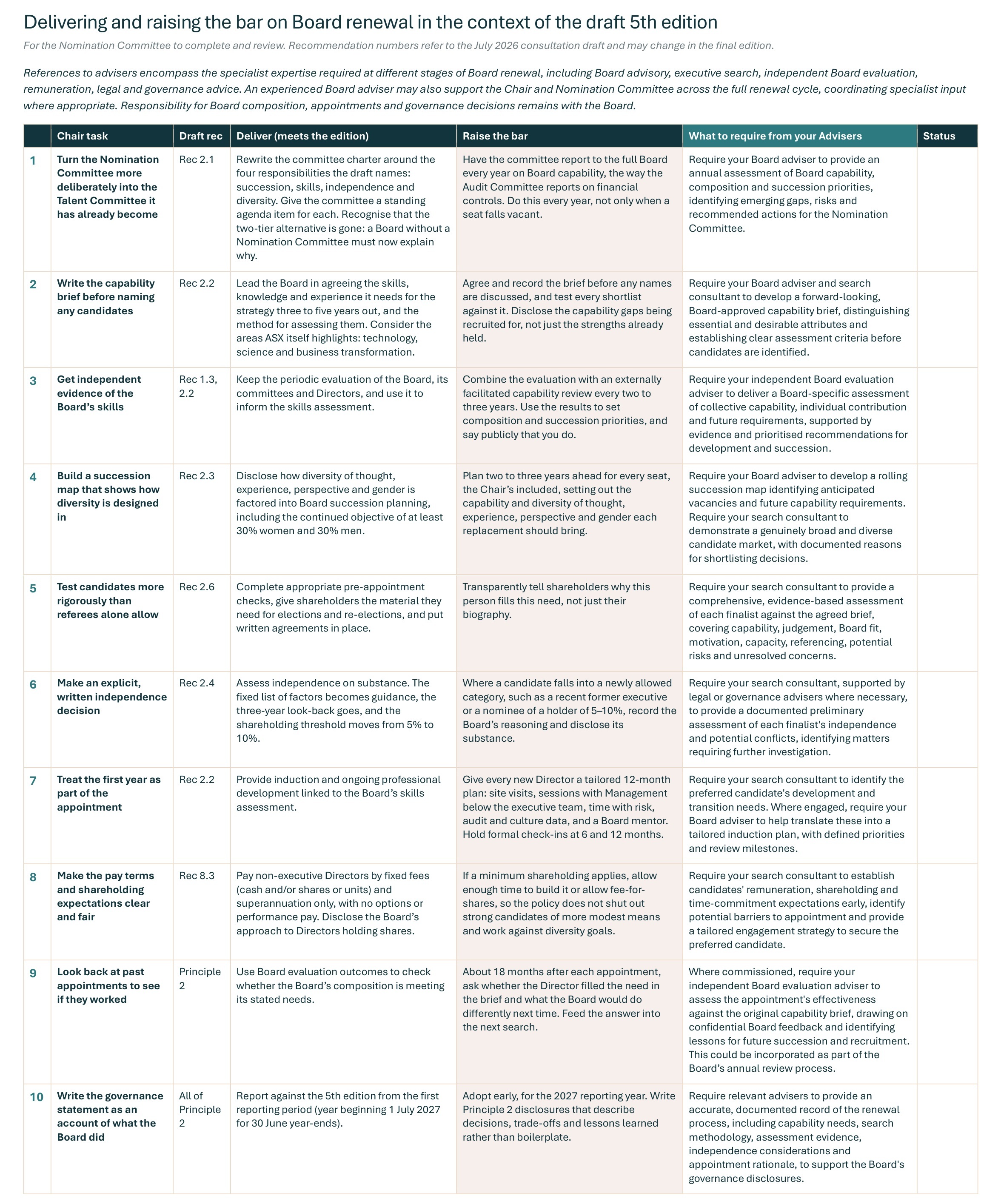
The checklist in the Annex sets out ten tasks. For each one, the Deliver column is what the edition expects. The Raise the Bar column goes further, to show the Board has genuinely adopted the changes rather than just complied. The “What to require from your Advisers” column suggests what to look for in an external partner and the “Status” column is left blank for the Chair and / or Nominations Committee to complete and track at each meeting.
The Choice for Chairs
There are two ways to approach the 5th edition. One is to treat it as a reporting update, adjust the wording, and keep recruiting through the same approach and networks. The other is to recognise that the edition makes visible something stakeholders have long believed: Board quality is decided by who you have around the table and how well you set them up to succeed. Boards that take the second approach will appoint Directors who make a difference and will be able to show it publicly.
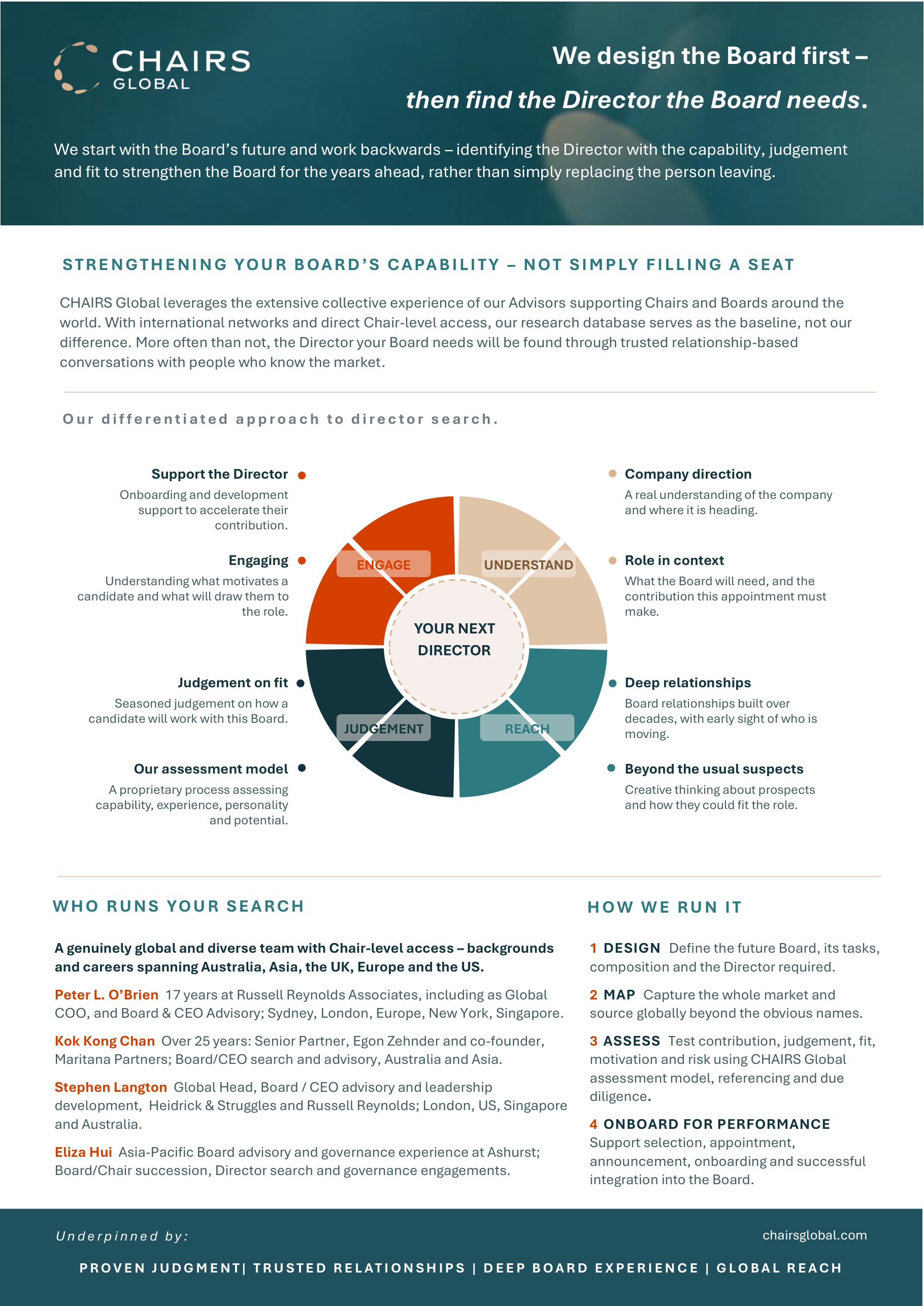
CHAIRS Global runs Board renewal and NED search to this standard.
The draft could still change before ASX finalises it in early 2027. The direction is unlikely to change.
Annex: Chair’s Ten-Task Checklist
Copyright © CHAIRS Global. All rights reserved. This publication is the intellectual property of CHAIRS Global and is provided exclusively for the use of authorised recipients. It may not be reproduced, distributed, shared, quoted or transmitted in whole or in part without the prior written permission of CHAIRS Global.
This was a complimentary article
Become a member to access our full suite of intelligence.
Become a Member