When the CEO’s Private Life Becomes the Chair’s Business

Preamble
When a celebrated chief executive is exposed over a relationship, the board’s question arrives in public, at speed and with the share price already moving. In the most recent case, set out below, a board went from a public statement of confidence in its founder and CEO to his exit in four days, and close to US$500 billion of market value was lost along the way.
Stakeholders, media business and social reporters quickly grab their torches and pitchforks whenever such revelations come to light. We don’t wait to have the story spoiled by truth or evidence to the contrary. The media circus takes over. The damage is done before there is any formal or legitimate investigation or review. Do we enjoy finding flaw in those successful and privileged, do we need to express outrage at capricious standards in organisational levels? Or is the market and society projecting unforgiving moral values and protecting integrity, truth and honour as value protecting corporate instruments?
When does the CEO’s private life become, rightly, the Chair’s public life if they are doing the right thing by the organisation and its stakeholders?
Our paper explores the many cases like this one. It looks how boards responded and why, and it provides a more structured guide and checklist for future Chairs on how to approach such complex situations.
Introduction
When a chief executive is exposed for an inappropriate workplace relationship or affair, financial markets react with swift, measurable severity. Empirical research from Stanford University and broader corporate governance studies consistently show that news of executive personal misconduct triggers an average immediate share price decline of roughly three to four per cent within the first three trading days.
While that percentage may appear modest on paper, for large publicly traded corporations it routinely translates into hundreds of millions, or even billions of dollars in evaporated shareholder wealth. In the post-#MeToo era, heightened investor sensitivity to corporate governance and reputational risk has amplified these penalties, with modern studies finding that firms lose an average of more than two billion dollars in equity market value when sexual misconduct or undisclosed workplace relationships come to light.
Real-world corporate history illustrates how the scale of this market fallout depends heavily on the company’s size and the nature of the governance breach. When McDonald’s fired CEO Steve Easterbrook in 2019 over a consensual relationship with a subordinate, the company’s shares dipped by roughly three per cent, wiping out four billion dollars in market capitalisation before stabilising. Similarly, BP shed approximately two billion dollars in value when Bernard Looney abruptly resigned in 2023 after failing to disclose past relationships with colleagues. In 2010, Hewlett-Packard lost nearly ten billion dollars in a single day, an eight per cent plunge, following Mark Hurd’s departure over a relationship with a contractor and falsified expense reports.
Yet when an affair crosses into operational misconduct or threatens a company’s strategic core, the damage escalates dramatically.
Ultimately, Wall Street rarely punishes a company out of mere moral outrage; rather, investors rapidly price in three concrete financial vulnerabilities: key man risk, succession readiness, and compliance failures. If a chief executive is widely viewed as an irreplaceable visionary or the architect of a delicate turnaround, the sudden prospect of their departure creates an immediate leadership vacuum that triggers an aggressive sell-off. Conversely, when a board of directors demonstrates decisive governance by immediately naming a credible internal successor, the market’s initial shock is typically contained to a two or three per cent dip, allowing the stock to recover within weeks.
The deepest and most enduring collapses occur when an affair reveals deeper institutional rot, such as misused corporate funds, preferential vendor contracts, or regulatory violations, proving that in the eyes of the market, a CEO’s private lapse becomes a public liability the moment it compromises corporate integrity.
The Short Answer for Chairs
A board should not sit in judgement of a CEO’s marriage. It should rightly, however, judge three things the affair may reveal: Candour (did the CEO tell the board the truth?), Conflict (did the relationship touch power, money, information or a subordinate?) and Capacity (can this person still lead, represent and be believed?). Across two decades of cases, CEOs survive private infidelity surprisingly often. They rarely survive lying to their board.
Case in Point: Nvidia, November 2026
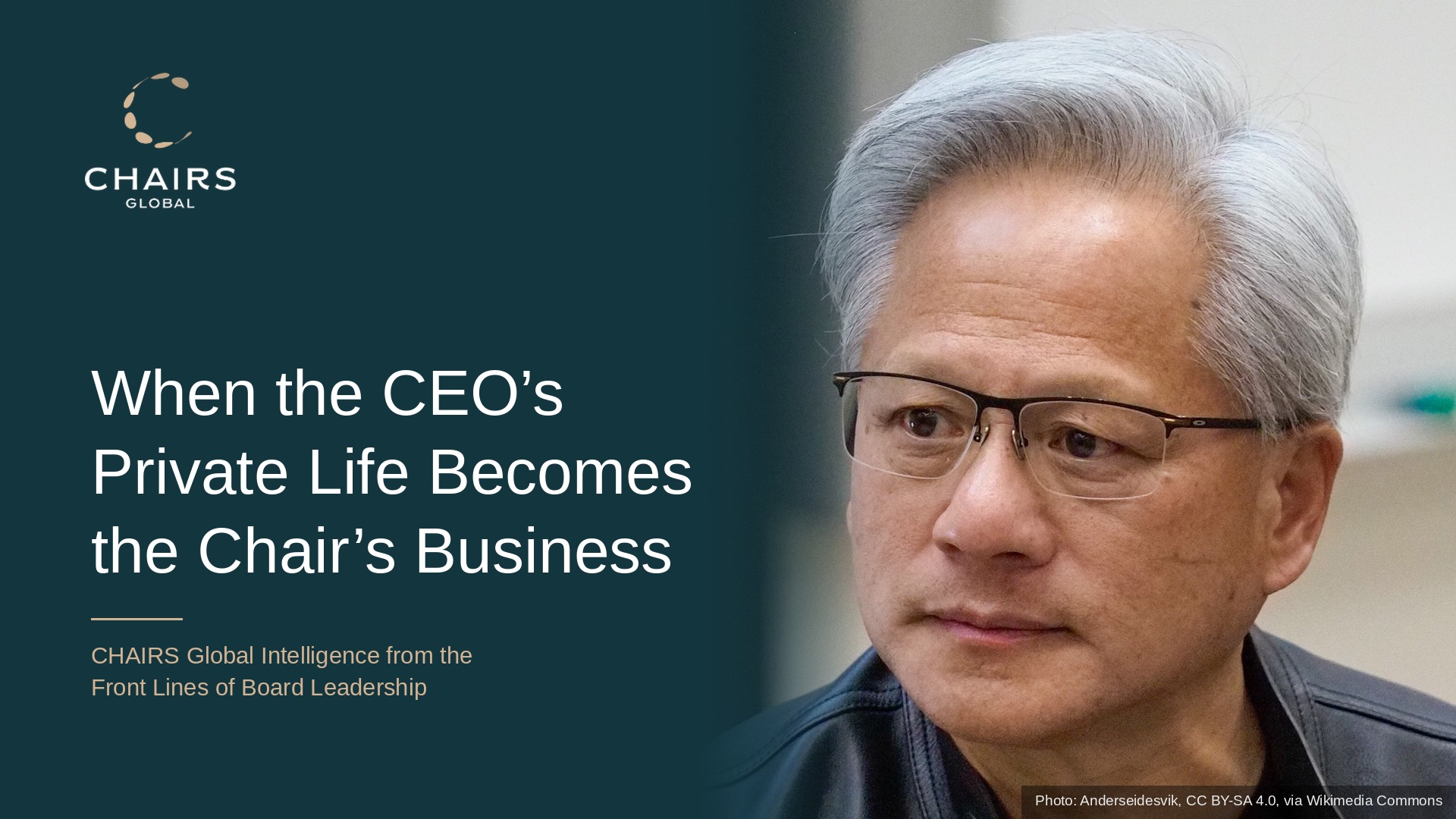
The case shows how fast the ground moves. On 8 November the board announced an independent investigation, led by a committee of independent directors with outside counsel, into reports that Jensen Huang had been the target of a foreign intelligence effort. The same day Huang told staff he had been unfaithful to his wife, and the board said it had confidence in him.
Three days later the New York Times reported an alleged second relationship, with an executive reporting to him. The board met on 11 November (US time) to consider removing him, and shares fell more than 9 per cent after hours. The next day the company announced that Huang had resigned as president, CEO and director, effective immediately; reports said the board had resolved the night before to remove him. The CFO, Colette Kress, was named interim CEO pending a search for a permanent successor. Close to US$500 billion of market value, about 11 per cent, was lost over the four trading days. A third alleged relationship, with another employee, was reported the same day.
Nvidia had no board Chair. On the day Huang left, the board appointed Harvey Jones as its first-ever Chair; until then it had been led by a lead independent director. A company worth more than US$4 trillion, run by its founder for 33 years, faced this crisis without the one role this guide is written for.
The lessons: the board’s first statement expressed confidence before the facts were in, and it lasted four days. The second allegation turned a private matter into a governance one (a reporting-line relationship). The board did not wait for any criminal or security finding before acting, and did not need to: its question is fitness and trust, and those other questions are for investigators and regulators. And the announcement named no ground for the exit, which leaves the board exposed if later findings show concealment.
Case facts as at 13 November 2026. The investigations, congressional questioning, exit terms and the permanent CEO appointment were open at that date. This case will be updated as findings are published; the guidance in this paper does not depend on how they resolve.
The Dilemma This Guide Addresses
The CEO is often the company’s most valuable asset, and the conduct may break no law or policy. Yet staff, customers, regulators and the public may see it as a moral failing. The Chair must decide whether this is a private wrong, a governance breach, or a leadership-ending loss of trust, and act consistently with what the company has said it stands for.
Our Observed Cases: Fourteen Decisions
Of the 14 cases below, the CEO left in 12. In almost every exit the stated ground was not the relationship itself but a breach of policy, a conflict, or misleading the board. The two survivors (Lloyds and Seven West Media) had boards that found no policy breach and kept the matter framed as private or procedural.
| Year, company and CEO | What came to light | Board’s decision | Stated ground |
|---|---|---|---|
| 2026 Nvidia Jensen Huang | Admitted affair; partner reportedly a suspected foreign intelligence asset; second alleged relationship with a direct report; a third alleged on the day he left | Investigation; resigned as CEO and director four days later, reportedly ahead of removal; CFO named interim; first board Chair appointed | None stated. Reported concerns: national security, candour, reporting-line relationship |
| 2025 Super Retail Group (ASX) Anthony Heraghty | Undisclosed relationship with the HR chief | Board first defended him; dismissed him two years later | Prior disclosures “not satisfactory” |
| 2025 Nestlé Laurent Freixe | Undisclosed relationship with a direct subordinate | Dismissed, no exit package | Code of conduct breach |
| 2025 Astronomer Andy Byron | Concert kiss-cam footage with the Chief People Officer | Leave, then resignation accepted | Leaders must set the standard |
| 2025 Kohl’s Ashley Buchanan | Steered contracts to a romantic partner | Fired for cause | Undisclosed conflict of interest |
| 2023 BP Bernard Looney | Past relationships with colleagues, not fully disclosed | Resigned; later dismissed for serious misconduct; £32.4m forfeited | Knowingly misled the board |
| 2019 McDonald’s Steve Easterbrook | Consensual relationship with an employee* | Exit without cause; later sued, >US$105m returned | Policy breach; then lying and concealment |
| 2018 Intel Brian Krzanich | Past consensual relationship with an employee* | Resigned | Non-fraternisation policy |
| 2016 Lloyds Banking Group António Horta-Osório | Alleged affair during a business trip | Kept; Chair found “no case to answer” on expenses | No policy or expense breach |
| 2016 to 2017 Seven West Media (ASX) Tim Worner | Affair with a former employee, made public | Kept after investigation | No misuse of company funds found |
| 2012 Best Buy Brian Dunn | Close personal relationship with an employee | Resigned; founder-Chair also quit the chair | Extremely poor judgement |
| 2010 Hewlett-Packard Mark Hurd | Harassment claim by a contractor; claimed false expense reports | Resigned with severance | Business conduct standards |
| 2007 BP Lord Browne | Lied in court about how he met a former partner | Resigned immediately | Personal integrity |
| 2005 Boeing Harry Stonecipher | Affair with a senior executive | Forced to resign | Poor judgement; impaired ability to lead |
Annex A reveals more of the stories in our micro-case studies for these situations if you want to read the gossip pages further
What the Cases Teach
The truth is, the affair itself is almost never the stated reason a CEO goes. Five patterns decide the outcome.
- Lying to the board is fatal; infidelity often is not. Looney, Heraghty, Easterbrook and Browne fell on candour. Horta-Osório and Worner survived because investigations found no breach and no deception.
- Power changes everything. A relationship with a subordinate, HR chief, vendor or anyone with access to secrets is a governance matter: conflict, coercion risk, favouritism, security. Freixe, Krzanich, Buchanan and Byron all fell on this line. Nvidia sat on it more than once.
- The second revelation kills. Boards that pronounce confidence early (Super Retail, Nvidia, Barclays in 2018, McDonald’s on its exit terms) lose credibility when more comes out. The board’s own judgement becomes the story.
- “Indispensable” is a succession failure, not a reason to keep someone. Lloyds investors and Nvidia commentators made the same point a decade apart. Boards with a ready successor (Nestlé, Astronomer) act cleanly; boards without one hesitate and bargain.
- Context sets the bar. Boeing hired Stonecipher to restore ethics; Lloyds is a regulated bank; Nvidia carries national-security weight. The same conduct means different things in different companies. Judge against what this company has publicly promised.
On the shareholder-versus-society question: the survivors were not saved by shareholder power so much as by a finding of no rule broken. Shareholders’ real concern, in every case, was key-person risk and whether the board was in control.
Thought of a fellow Chair while reading this?
Share this complimentary paper with them.
How a Chair Should Frame the Judgement
Separate the moral question from the governance question, and decide only the second. The board is not the CEO’s spouse, priest or jury. It is the steward of trust, risk and the company’s stated values.
First 48 Hours: Process Before Verdict
- Take control of the process, not the narrative. Convene the independent directors without the CEO. Where the Chair is close to the CEO, hand the matter to the Senior Independent or Lead Independent Director (the Nestlé and Super Retail contrast).
- Appoint independent investigators reporting to a committee of non-executives, not to management, HR or the general counsel who reports to the CEO.
- Say nothing about confidence. State that the board is investigating, will act on findings, and that the business is running. Premature support is the most common board error in these cases.
- Consider interim measures. Leave, recusal from affected decisions, ring-fencing the other party from the CEO’s authority, preserving devices and records.
- Protect the other person and any whistleblowers. They are often junior, exposed and the subject of gossip. Retaliation converts a private matter into a legal one (Super Retail).
The Five Tests
Work through these in order. The first “yes” usually decides the matter.
- Candour. Has the CEO told the board the whole truth, now and in any past disclosure? A knowing untruth to the board is, on the cases, close to automatically fatal.
- Power and conflict. Was the other person a subordinate, in the reporting line, in HR, a supplier, a regulator, a competitor, or a foreign-linked counterparty? Was any decision, payment, promotion or information affected?
- Policy and law. Does it breach the code of conduct, conflict or relationships policy, expenses rules, continuous disclosure, or security obligations? Apply the rule as you would to any manager.
- Company resources and risk. Were company money, travel, time or data used? Is there blackmail, security or regulatory exposure?
- Capacity to lead. Setting aside 1 to 4: can this person still credibly lead staff, face regulators and customers, and embody the values the company sells? Ask how it looks to a junior female employee, a regulator and a long-term investor, not to the market this week.
| What the board finds | Likely proportionate response |
|---|---|
| Private, consensual, outside the company, fully disclosed, no breach | Treat as private. Brief, private reminder of expectations. No public comment beyond “a personal matter”. |
| As above but public embarrassment and reputational damage | CEO’s own apology to staff; board reviews whether capacity to lead is affected; possible remuneration consequence. |
| Policy breach (undisclosed workplace relationship) but honest once asked | Serious sanction to dismissal, per the policy as applied to all staff. |
| Conflict of interest, misuse of funds, or security exposure | Dismissal for cause is the norm. |
| Misled the board or investigators | Dismissal for cause, forfeiture and clawback. |
The Indispensable CEO Trap
Performance is relevant to sanction and to timing, never to whether the truth matters. Ask: would we apply this standard to a regional manager? If not, the culture message to every employee is that rules bend for stars. Equally, do not sack to appease a news cycle when the facts show a private failing with no breach; that is unfair and sets a precedent the board may not want. A useful discipline: write down the decision and its reasons as if they will be read aloud in court, at the AGM and by the most junior employee. If any of those audiences would find it unprincipled, revisit it. The ‘pub test’ carries no regulated mandate, but it’s a powerful instinct of does a resolution make sense to the stakeholders at large.
Remuneration
Decide the exit terms only after the investigation, never in the first week. Preserve the right to convert a resignation into dismissal for cause (BP), lapse unvested awards (Super Retail) and claw back if concealment emerges later (McDonald’s).
How to Communicate the Judgement
The best board statements in these cases are short, name the rule, and say what happens next. The worst express confidence, then reverse.
| Stage | Say | Avoid |
|---|---|---|
| Allegation surfaces | The board is aware, has appointed independent investigators reporting to non-executive directors, and will act on findings. The business is operating normally. | “Full confidence in the CEO.” Any comment on the private relationship. |
| Decision: CEO stays | What was examined, that no breach of policy or law was found, any sanction applied, and that the matter is closed as a private one. | Praising performance as the reason. It tells staff rules bend for stars. |
| Decision: CEO goes | The specific ground (policy, conflict, candour), effective date, interim leader, remuneration treatment. | Moralising about the marriage. Vague “personal reasons” that later unravel. |
Audiences, in order: the board itself (unanimity or a clear majority, minuted); the other party and whistleblowers (privately, with support); regulators and the ASX or other exchange where continuous disclosure applies; staff, ideally in the same hour as the market; major shareholders, by the Chair personally; then media.
Model language. Nestlé’s Chair needed one sentence: a necessary decision, because values and governance are the company’s foundations. Astronomer said leaders are expected to set the standard and that standard was not met. BP named the precise wrong: knowingly misleading the board. Each tied the decision to a principle the company already held, not to the private conduct.
The CEO’s own voice. Where the CEO stays, an apology to staff in their own words helps (Horta-Osório, and Huang’s initial note). It should come from the CEO, not be drafted as a board statement, and should not pre-empt the investigation.
Mitigation: What to Put in Place Before It Happens
Most of these crises were decided before they began, by the policies, structures and succession plans the board did or did not have.
- A clear relationships and conflicts policy that names the CEO. Mandatory disclosure of any relationship within the reporting line, with HR, or with suppliers, to the Chair or a named independent director. Intel and Nestlé could act fast because the rule was written.
- An annual written attestation by the CEO to the Chair on relationships, conflicts and anything that could cause embarrassment or compromise. It turns a future lie into a clear breach
- A whistleblower channel that bypasses the CEO and any close Chair, reporting to the audit or risk committee chair, with tested anti-retaliation protections.
- A standing protocol for allegations against the CEO. Who leads (SID or Lead Independent Director), which external firm, how the CEO is recused, what is preserved. Agreed in calm, used in crisis.
- Real emergency and permanent succession plans, reviewed yearly, with a named interim. “No obvious successor” is the board’s failure, not the CEO’s leverage.
- Contracts that make consequences possible: “cause” defined to include misleading the board and breach of the code, malus and clawback on all variable pay, and no agreed exit terms before an investigation ends.
- Security and counter-intelligence briefings for CEOs of strategically sensitive companies, including on approaches through personal relationships. Nvidia shows the cost when such an approach is even alleged.
- A Chair relationship that is close but not captured. The Chair must be someone the CEO would confide in early, yet whom staff trust to act against the CEO if needed. Super Retail’s filings show the cost when staff believe the Chair is too close.
- A Chair in place before the crisis. A lead independent director can run an investigation, but a board that has to appoint its first Chair in the middle of a CEO crisis is building its structure while using it.
- Culture signals from the top. Apply the rules visibly to senior people. Every exception made for a star is remembered.
Annex A: Micro-Case Studies of Our Selected Cases
Micro Case Studies for Awareness and Benchmarking Approaches
Nvidia (2026). The board moved quickly to an independent committee and outside counsel, which was right. But its first statement also voiced confidence in Huang, three days before a second allegation surfaced. Nvidia’s bylaws let a majority of directors remove the CEO with or without cause, and all directors bar Huang were independent. Commentators had criticised the absence of a public succession plan. Four days after its statement of confidence, the board announced Huang’s resignation as CEO and director, reportedly after resolving to remove him, named the CFO Colette Kress interim CEO and appointed Harvey Jones as the company’s first-ever Chair; until then the board had been led by a lead independent director. The announcement thanked Huang and named no ground for his exit. Impact: close to US$500bn of market value lost in four trading days. The lessons: confidence expressed before the facts are in has a short shelf life; a board without a Chair had to create one mid-crisis; and an exit with no stated ground leaves the board exposed if later findings show concealment (see McDonald’s). Facts as at 13 November 2026.
Super Retail Group (2023 to 2025). A whistleblower tip in November 2023 alleged a secret relationship between the CEO and HR chief. In April 2024 the board told shareholders an externally supported review found the allegations unsubstantiated. The two lawyers who raised it were terminated and sued. In September 2025 the board sacked Heraghty after “new information” from him, lapsing incentives worth about A$3.4m. A confidential settlement followed. The lesson: the board relied on the CEO’s word over the whistleblowers’, and the cost landed on the people who spoke up and on the board’s own credibility. Court filings alleged staff felt they could not raise concerns because the Chair was close to the CEO.
Nestlé (2025). A hotline report in spring prompted an investigation that was initially inconclusive. When a second investigation, overseen by the Chair and the Lead Independent Director with external counsel, confirmed the relationship, the board dismissed Freixe the same evening and named a successor at once. The Chair’s statement was one line: a necessary decision, because values and governance are the company’s foundations. Clean, rule-based, fast, with a ready successor.
Astronomer (2025). The board placed Byron on leave, opened a formal investigation, and accepted his resignation within three days, naming a co-founder interim CEO. Its statement anchored on values, saying leaders must set the standard in conduct and accountability. The lesson: in a viral moment the board’s job is speed and a stable interim, not a moral essay. The relationship involved the head of HR, which made a private story a governance one.
Kohl’s (2025). An outside-law-firm investigation found Buchanan directed a multimillion-dollar deal on highly unusual terms to a vendor with whom he had an undisclosed relationship. Fired for cause after about 100 days. The board’s filing never mentioned romance; it was framed entirely as a conflict of interest, which is the right test.
BP: Looney (2023). The board had examined his past relationships in 2022 and accepted his assurances. When new allegations came in 2023 he resigned, admitting he had not been fully transparent. The board then converted the resignation to dismissal for serious misconduct and forfeited up to £32.4m, concluding he “knowingly misled the board”. A headhunter called it a clear message that leaders cannot lie to the board and get away with it. BP spent months without a permanent CEO.
BP: Browne (2007).* Not an affair and not a married man: Browne resigned the day a court found he had lied about how he met his former partner. His sexuality was not the issue; the untruth under oath was. He left at once, and the board let him own the exit.
Lloyds: Horta-Osório (2016). The Sun alleged an affair with Dr Wendy Piatt during a business trip to Singapore. The Chair, Lord Blackwell, reviewed the expenses and found he had paid personal costs himself. Horta-Osório emailed 75,000 staff expressing deep regret for the damage to the group’s reputation. Investors’ reaction was not moral but practical: they pressed for succession planning and less reliance on one man. On your hypothesis: the government still owned about 9 per cent, but the board’s stated reason was that no rule was broken, not that shareholders outranked society. The earlier 2011 episode, where the 41 per cent government stake mattered, concerned his return from medical leave, not an affair. He served until 2021. Coda: at Credit Suisse in 2022 he resigned as chair over Covid quarantine breaches. Same man, different board, and a clear rule this time.
McDonald’s: Easterbrook (2019 to 2021).* The board found a consensual relationship with an employee breached policy and let him go “without cause”, with a large package. A year later it discovered he had concealed other relationships and deleted evidence, and sued. He returned more than US$105m. The lesson: investigate before you agree terms, and keep clawback rights alive.
Intel: Krzanich (2018).* A past consensual relationship breached a non-fraternisation policy covering all managers. Intel stated the policy applied to everyone, the CEO included. Consistency was the message.
Seven West Media: Worner (2016 to 2017).* The former employee went public after a legal dispute. The board, led by Kerry Stokes, investigated, found no misuse of funds beyond minor items, and kept him. He survived, but the episode dogged the company’s culture debate for years. A survivor, at reputational cost.
Best Buy: Dunn (2012).* An audit committee investigation found extremely poor judgement in a close relationship with a young employee. Dunn resigned. Founder and Chair Richard Schulze also gave up the chair because he had heard of the concerns and not told the audit committee. The Chair’s own conduct was judged too.
HP: Hurd (2010).* Investigation of a harassment claim by a contractor found no harassment but inaccurate expense reports concealing the relationship. The board said he had breached its standards of business conduct; he left with severance. Shares fell sharply and Oracle hired him within weeks; Larry Ellison publicly called the board’s decision a mistake. The lesson: a sound ground (falsified records) can still look petty if the board does not explain it.
Boeing: Stonecipher (2005).* Brought back to restore ethics after procurement scandals, he was found in a consensual affair with a female executive. The board forced him out, saying the facts reflected poorly on his judgement and would impair his ability to lead. Context made the decision: a CEO hired to embody integrity could not survive a breach of it.
Copyright © CHAIRS Global. All rights reserved. This publication is the intellectual property of CHAIRS Global and is provided exclusively for the use of authorised recipients. It may not be reproduced, distributed, shared, quoted or transmitted in whole or in part without the prior written permission of CHAIRS Global.
Thought of a fellow Chair while reading this?
Share this complimentary paper with them.
This was a complimentary article
Become a member to access our full suite of intelligence.
Become a Member