Winning Trust and Confidence at the AGM: A Guide to Preparing for and Handling the Hard Questions as Chair

Preamble
This paper had a cheeky flippant working title while it was being prepared: “The Artful Dodger”. But that would betray the seriousness of the topic, shame the technique into how to avoid the topic as well as risk a plagiary case with Charles Dickens’s estate. An AGM should be something to be respectful of, a moment to enable that so important connection and forum with those who actually own your organisation. And you.
Of course, it is a platform for being questioned and being challenged as well as being heard and recognised. A Chair’s mindset about the audience sets the tone and the outcome in every case. Whether that ‘mum and dad’ pension fund micro-holder, or that titan institutional investor, or that irritating-but-makes-a-fair-point proxy adviser, these are valuable points of scrutiny from people who, like you, also want to see value created and protected. So they are on your side, though at times it might not feel like that.
We can control our presentations to them and then hold our breath for Q&A. Being better prepared for those questions, before, during and after, becomes such an apparent point of success as well as calming the uncertainty of how this will go.
This paper reveals that successful Chairs lean into the hard questions. It’s an opportunity to demonstrate your clarity and understanding and therefore control of an issue. They embrace and look forward to the opportunity to share more words of detail, explanation, storytelling than the word count of their AGM speech allowed.
Words of Wisdom from Front Line Chairs
Remember they are challenging the Chairman of a company. Not you personally. Don’t allow personal pride and offence to distract. Of course you want to shout back ‘what would you know, you haven’t stood in my shoes for the past year, you don’t know how hard we are trying, you don’t know how little support I really have’ … and all the other voices frantic to come out. Forgive them. They are trying hard to do their job as well.
Don’t just tell them, teach them. Explain how you came to decisions and the variables and options considered. Show your working. Stop them from having to follow you out of faith alone rather than giving evidence they can believe.
Some questions you really should expect. The ones you can see and fear coming even if they are justified. So, prepare your response. Some questions were not seen coming though. For those, collect those buckets of facts, stories that bring your actions and progress to life.
Think about ‘intent’ and ‘impact’. How you respond to a question or challenge and how you receive that challenge. The intent of a question or challenge is rarely to shame or reveal incompetence or readiness. It is to seek understanding and clarification. The impact of your response might come across as defensive or dismissive when your intent was opposite. Be sure to read the room and seek understanding rather than presume you are in a witness dock!
The Short Answer
There is no proven formula for a great AGM answer. Of course. But the research does point to a very helpful and repeatable structure. We found no research study that tests Chair or CEO answers at AGMs directly. This guide therefore draws on the experience of the CEOs and Chairs we proudly serve as well as earnings-call research, trust-repair experiments, crisis studies and real AGM cases.
The pattern across that evidence is clear: shareholders can absorb bad news, but evasion, blame and a lack of control cost trust. Four findings carry most of the weight:
- Ownership signals control. Companies that took responsibility for poor results were seen as more in control and had better later share prices in one long-run study.
- Weak excuses backfire. Experienced analysts judged a company more harshly after an implausible excuse than after no explanation.
- Non-answers are noticed. Listeners catch an attempted dodge when their attention stays on the question, and they then rate the speaker lower.
- Action outweighs words. Substantive amends rebuilt cooperation better than explanations alone.
From the many Q&A sessions with CEOs and Chairs we have both observed and researched, the apparent ideal pattern of response structure is what we are calling a ‘5A’s’ answer: Acknowledge, Answer, Accept, Act, Anchor. It gives the direct answer early, owns what was controllable, shows what has changed, and tells shareholders how to measure progress.
The deeper lesson concerns preparation. A Chair can only sound in control of an issue that they actually do control, so most of this work happens months before the meeting.
This guide assumes an Australian ASX-listed company. It is not legal advice, and the disclosure points need review by your company secretary and counsel.
What the evidence says
Fifteen studies that we found on this topic augment our own experiences with CEOs and Chairs over the past 25 years supporting them in these moments. These shape our guide, and the strongest concern ownership, plausibility and action. Strength reflects how close the evidence is to a real setting, not just its statistical quality.
| Finding | Evidence | What it means at the AGM | Strength |
|---|---|---|---|
| Owning failure goes with better outcomes | Lee, Peterson & Tiedens: 21 years of shareholder letters from 14 companies. The five most self-blaming beat the five most other-blaming by 14% to 19% a year later. | Name the internal cause and why and how. | Moderate: correlation, small sample |
| Self-blamers recover, blamers keep sliding | Corporate honesty study: 150 press releases, 1993 to 2009. Those who blamed themselves gave more detail and later improved. | Specific ownership shows you have found the problem. | Moderate: correlation |
| Investors prefer internal, controllable reasons for bad news | Chen, Han & Tan: investors set lower earnings estimates when bad guidance was blamed on outside factors. | Lead with what you control, then add outside factors. | Moderate: experiments |
| Implausible excuses backfire | Barton & Mercer: 94 experienced analysts. An implausible excuse produced lower forecasts than no explanation and hurt credibility. A plausible one softened the reaction. | Cite outside causes only if a sceptic would accept them. | Strong: professionals in an experiment |
| Non-answers follow a pattern | Gow, Larcker & Zakolyukina: about 11% of analyst questions get non-answers. Negative, uncertain, complex or detailed questions trigger more. | Your urge to dodge is predictable, so prepare for those questions. | Strong: large field data |
| Dodges work only until attention stays on the question | Rogers & Norton: four studies. Recall of a dodged question rose from 39% to 88% when it stayed on screen. A blatant dodge scored 2.75 against 3.46 on a 6-point rating. | The person at the microphone keeps the question in view, so answer it. | Moderate: mock debates |
| Fumbling a true answer also costs you | Rogers & Norton: a fluent speaker scored 3.31 and a disfluent speaker 2.78 on identical words. | Rehearse until the true answer flows. | Moderate: mock debates |
| Apologies work by their parts | Lewicki, Polin & Lount: 755 people. Responsibility mattered most, then an offer of repair. Asking forgiveness mattered least. | Say what you did and how you will fix it. Do not ask for forgiveness. | Moderate: written scenarios |
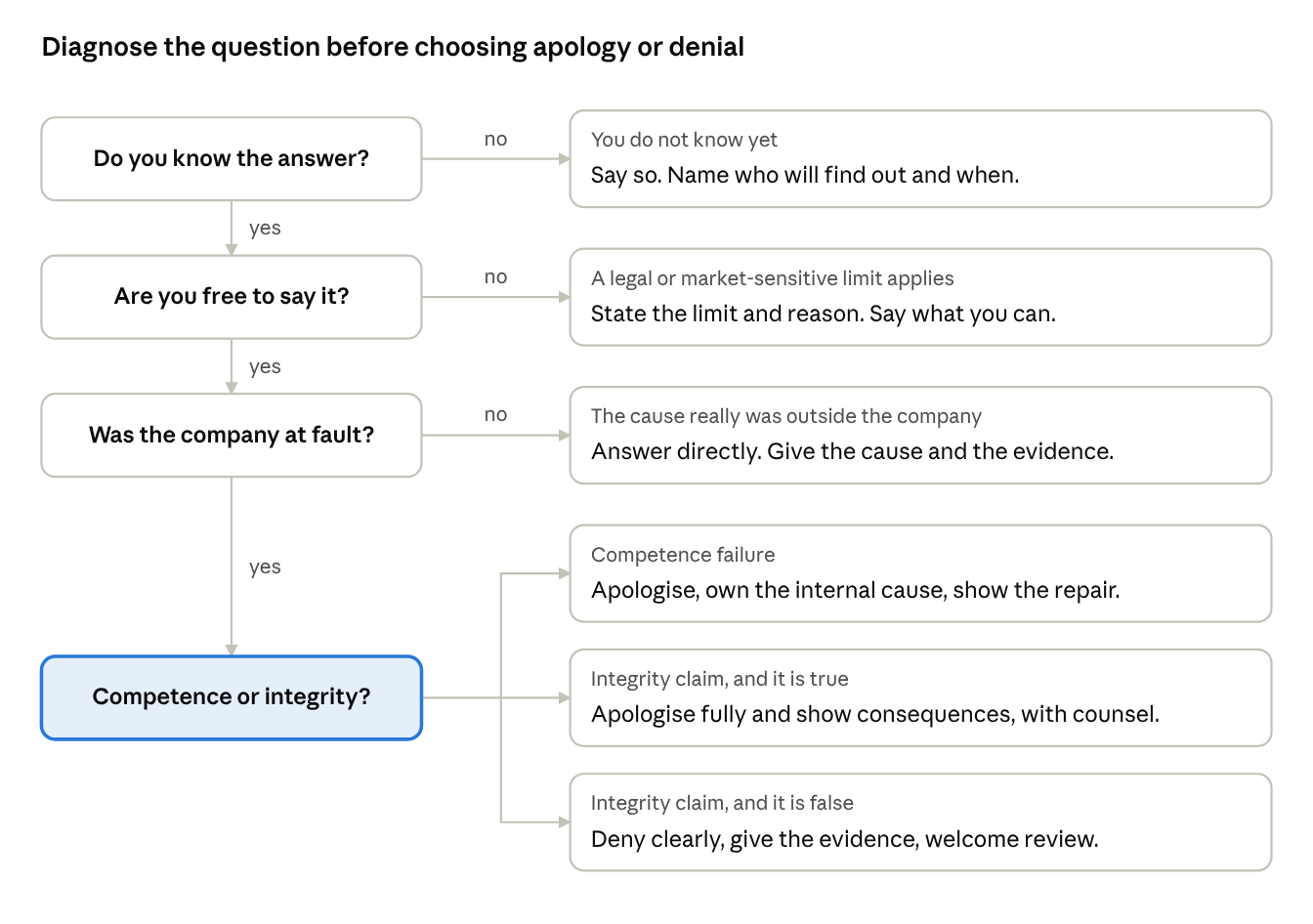
| The right response depends on the type of breach | Kim et al. 2004: apology repaired competence breaches better. Denial repaired integrity breaches better, but only if innocence was later shown. | Diagnose competence or integrity before you respond. | Strong: core trust research |
| Saying nothing is a weak position | Ferrin et al. 2007: silence neither addresses guilt nor signals redemption. | Pair any legal limit with what you can say. | Moderate: lab studies |
| Action outperforms explanation | Bottom et al. 2002: substantive amends beat explanations alone. | Lead the repair with what is already done. | Moderate: experiment |
| Scripted answers can be detected | Lee 2016: 40,820 earnings calls. The most scripted firms lost 0.2% over two days against a 0.1% sample gain. | Prepare facts and logic, not sentences to recite. | Strong: large field data, though earnings calls |
| Voice carries information | Mayew & Venkatachalam: 1,647 calls. Negative vocal cues preceded lower returns, most strongly under pointed questioning. | Your tone will reveal unresolved issues, so resolve them first. | Moderate: software-measured emotion |
| Inflated positivity is a warning sign | Larcker & Zakolyukina: executives whose results were later restated used more extreme positive words. | Replace superlatives with numbers. | Moderate: the model is imperfect |
| Honest uncertainty is acceptable if delivered with confidence | Gaertig & Simmons: 11 studies, 4,806 people. Confident advisers were favoured, but uncertain advice was not penalised. | Give the range and risk in a steady voice. | Strong: replicated across studies |
Two further findings support the guide. Receptive language improved how people were rated in disagreements and reduced personal attacks in the field. Disclosing a problem yourself reduced the attention paid to later negative publicity and its effect on reputation.
The most effective formula: the ‘5A’s’ response
I share this out of interest and curiosity as a pattern recognition, not as some attempt at formulaic performance and instruction: A strong answer to a hard question has five beats and should take about 60 to 90 seconds. The direct answer arrives by the second sentence, because delay reads as evasion.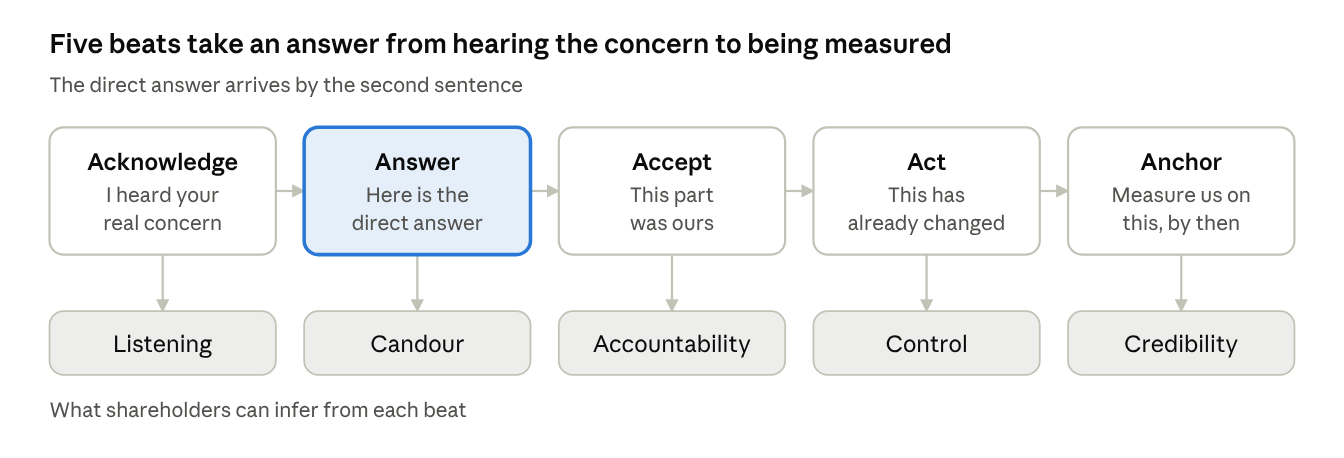
The 5A’s response: five elements and what each one signals
Four rules give the structure more integrity and grounding:
- Answer the question asked. If you can only answer part of it, say which part.
- Stop after the apology. Do not follow it with “but” or with good news.
- Use one number. Choose the figure that answers the question, then stop adding detail.
- Promise only what you can report next year. Each Anchor becomes a question at the next AGM.
Adapt the structure to the question. A simple factual question needs only Answer and a short reason. Where nothing went wrong, drop Accept and explain the decision instead.
Patterns by question type
Every hard question tests something specific, so classify it before you answer. In 2025, King & Wood Mallesons found AGM questions were less about broad themes and more about testing board credibility and governance. Many drew directly on published disclosures.
| Question type | What is being tested | Best structure | The trap |
|---|---|---|---|
| Missed target or weak result | Do you understand why? | Full 5A, with internal causes first | Leading with the market |
| Harm to customers, staff or community | Do you care, and are you accountable? | Acknowledge the harm, apologise, then Act and Anchor | Talking about the company’s pain |
| Executive pay | Are the rewards fair for the owners’ experience? | Chair or remuneration chair answers. CEO acknowledges how it looks. | Defending your own pay |
| Integrity allegation | Are you honest? | Use the decision path below | Apologising or denying before you know the facts |
| Legal or market-sensitive limit | Are you hiding behind the rule? | State the limit and reason, share what is public, give a time for the update | A bare “no comment” |
| Question you cannot answer | Do you know your business? | Say so, name who will find out, give a date | Improvising a number |
| Forecast or hypothetical | Are you overpromising? | Give the range, the assumptions and the main risk | False certainty |
| Personal attack | Can you stay composed? | Acknowledge the feeling, state the fact, return to the plan | Answering the insult |
| Repeated single-issue activism | Will you engage fairly? | Respect the concern, refer to the published position, give one new fact | Sarcasm or visible impatience |
| Individual customer complaint | Do you treat people decently? | Express regret, offer direct follow-up, move on | Debating the case in public |
The Chair runs the meeting and decides who answers. The Governance Institute notes that chairs usually refer questions to the CEO and occasionally the CFO. It also suggests information booths or phone support so that customer issues stay separate from shareholder business.
Decision path for questions of fault
Use this path in preparation, not live. It reflects the Kim report and study we found, that the right response depends on the type of breach and on what the evidence later shows.
Words: what builds trust and what signals defence
Defensive language usually protects the speaker, while trustworthy language gives the listener something to check. Rows marked “Research” trace to a finding above. Rows marked “Judgement” are practitioner inference.
| Avoid | Why it fails | Use instead |
|---|---|---|
| “Unprecedented market conditions” | Puts the cause outside your control | “Prices fell for everyone. Our exposure was our decision.” |
| “Mistakes were made” | Hides who made them | “We made the mistake. I approved the plan.” |
| “We’re sorry if anyone was upset” | Doubts the harm | “We’re sorry. We overcharged 40,000 customers.” |
| “I apologise, but our results were strong” | Cancels the apology | Stop after the apology and move to the repair |
| “I can’t comment” | Silence signals neither innocence nor repair | “I can’t discuss X because of Y. I can tell you Z.” |
| “Fantastic”, “world-class”, “outstanding” | Sounds like spin under pressure | Specific numbers and dates |
| “We’re confident it will be fine” | False certainty | “I expect X. The main risk is Y.” |
| “You’ve misunderstood” | Negation escalates conflict | “Here is how we see it, and where we agree.” |
| “That’s a great question” | Sounds like a stall | Restate the concern in one sentence |
| “As set out in the annual report” | Sounds dismissive | Answer in a sentence, then point to the page |
| “We take this very seriously” | Claims a feeling without proof | Say what you did about it |
| “We’re on a journey” | Promises no end point | Give the next milestone and its date |
Use “I” for accountability and “we” for the work of the organisation. The ‘I’ is always used subordinate to the ‘We’. Never name a junior employee as the cause. If a person’s conduct matters, describe the failed control and say what consequences followed.
Delivery should stay plain. Speak in short sentences, slow down for the hard part, and let a short silence stand. Do not smile through bad news or rush past it.
Mindset and self-control
Treat the AGM as a review by the owners, not a trial. The aim is to direct your stress, not to eliminate it.
| Shift from | Shift to | Why it helps |
|---|---|---|
| Defendant | Steward reporting to owners | The Governance Institute describes members as owners and directors as their stewards. |
| Winning the exchange | Being accurate and useful | You cannot lose an exchange that you never entered as a contest. |
| Answering one angry person | Speaking to everyone watching | Staff, media, regulators and quiet shareholders judge how you treat the critic. |
| Protecting today’s reputation | Protecting next year’s credibility | Each overstatement becomes next year’s hard question. |
| Knowing everything | Knowing what you know | Honest uncertainty is accepted when it is delivered with confidence. |
| Feeling calm | Feeling ready | Stress can help performance when you read it as useful energy. |
Control is shown through specifics
Shareholders cannot see your intent, so they infer control from detail. A CEO in control can name the cause, the owner, the change, the date and the measure without notes.
Test each major issue with six cold questions:
- What exactly happened?
- Why did our controls allow it?
- What was my part in it?
- Who owns the fix?
- What has already changed?
- What would show that it is fixed, and what could still go wrong?
If you cannot answer all six, the gap is in the management of the issue.
A self-control routine
- Weeks before: build exposure. Practise with hostile questions until the pressure feels familiar. This step is practitioner judgement, and it pairs well with the reappraisal below.
- Before the meeting: reframe the arousal. Tell yourself that a fast pulse is your body preparing you to perform. Research on arousal reappraisal used this kind of instruction before public speaking.
- Backstage: talk to yourself by name. “Sarah, you know this issue. Answer the owner.” Kross and colleagues found that non-first-person self-talk helped people manage stress around public speaking.
- At the microphone: pause first. Listen to the end, breathe once, write down one word, then start. This is judgement, and it also stops you from answering the tone instead of the question.
- If you feel provoked: name the feeling silently. Think “that’s anger”, then return to the facts. Affect labelling lowered self-reported distress in laboratory studies.
- Afterwards: review the tape. Note where you sped up, argued or added detail. Those moments usually mark the issues that remain unresolved.
Do not rely on saying “I am excited” alone. A 2025 replication of that popular public-speaking result reports a change in self-report but no observable improvement in performance.
Preparation playbook
Preparation should fix the issue first and rehearse the answer second. The timing below builds on the Governance Institute AGM checklist, with my additions for the CEO’s role as well as the Chair’s. Adjust it to your own calendar.
| When | What to do | Who |
|---|---|---|
| 3 to 6 months before | Audit trust risks: results questions, proxy adviser concerns, media, complaints, regulators and peers’ AGMs. Decide what must actually change. | CEO, Chair, company secretary |
| About 3 months before | Engage proxy advisers and major shareholders. Some advisers stop engaging once the notice of meeting is issued. | Chair, remuneration chair, investor relations |
| 6 to 8 weeks before | Build the hard-question book. Rank about 30 questions by likelihood and damage. Give each a one-page 5A brief of facts, not a speech. | Investor relations, CFO, general counsel |
| 4 weeks before | Map disclosure limits with counsel: what is public, what is sensitive and what is before a court or regulator. | General counsel, company secretary |
| 3 weeks before | Draft the addresses so they raise the top issues before shareholders do. Include what has changed and how it will be measured. | CEO, Chair |
| 2 weeks before | Run hostile rehearsals on video with people who will not defer to you. Include retail, activist, media and employee voices. Run at least two rounds. | CEO, CFO, outside coach or director |
| 1 week before | Agree with the Chair who answers what, the handover cues, time limits and how to handle disruption. Hold a full rehearsal with the Q&A. | Chair, CEO, company secretary |
| 1 day before | Call the Australian Shareholders’ Association and relevant holders to ask what they plan to raise. Check overnight news. | Company secretary, investor relations |
| On the day | Lodge prepared addresses with ASX by the start of the meeting. Keep legal support available. | Company secretary |
| Within 2 weeks after | Answer questions taken on notice, publish the answers, debrief, and log every commitment for next year. | CEO, company secretary |
Rehearse facts, not scripts
AGM guidance recommends scripts and prepared answers, while earnings-call research warns against sounding scripted. The two fit together once you separate the meeting’s formal script from its Q&A.
- Script the formal business. This covers the addresses, resolutions and procedure.
- Memorise facts for Q&A. Know the numbers, dates, decisions and limits, then say them in your own words each round.
- Script only where a slip would be costly. Lee himself concedes that scripting can be the lesser evil. Use counsel-approved wording for legal and market-sensitive matters.
Guardrails for Australian listed companies
- The right to ask: section 250S requires the chair to allow members as a whole a reasonable opportunity to ask about or comment on management.
- Disclosure: discuss only public information. The Governance Institute notes that disclosable information released inadvertently at the meeting requires an ASX announcement.
- Fairness and order: the chair may set reasonable limits, such as two questions per item of business, so that all members can take part.
- Climate answers: King & Wood Mallesons notes that modified liability under the climate reporting regime does not extend to AGM answers.
- Remuneration: a 25% or greater vote against the report two years running triggers a spill resolution. Institutional votes are usually lodged before the meeting, so engagement has to happen early.
Some worked examples (illustrative, not instructional)
The same facts can sound evasive or accountable, and the difference lies in structure. These examples use an invented company and invented figures. Replace them with your own facts, and have counsel review anything involving legal risk.
A dividend cut after reassurance
Question: “You told us last year the balance sheet was strong, then cut the dividend by 30%. Why should we believe you now?”
Defensive: “The whole sector has faced unprecedented headwinds. Our balance sheet remains robust, and we are confident in our long-term strategy.”
5A answer: “You’re asking whether my word last year can be trusted, and that’s fair. We cut the dividend by 30% because debt rose faster than I told you it would. Higher rates hit the whole sector, but the debt level was our choice. I recommended the Northern acquisition and underestimated its cost. Since March, we have sold two sites, frozen acquisitions and changed how the board tests debt. Judge us on debt below 2.5 times earnings by June. Energy costs are the main risk to that, and I will tell you early if it slips.”
Harm to customers
Question: “Criminals stole the data of 400,000 customers. Who is responsible, and has anyone lost their job?”
Defensive: “We were the victim of a sophisticated attack, and cyber security is an industry-wide challenge. We can’t discuss employment matters.”
5A answer: “You want to know who is accountable. As CEO, I am. Criminals carried out the attack, and they entered through a system we should have retired two years ago. We are sorry to the 400,000 customers who bore that risk. That system is now closed, every affected customer has been contacted, and the board reduced executive bonuses, including mine. Privacy rules stop me discussing individual employees. An independent review reports in March, and we will publish its findings.”
A challenge to your own pay
Question: “You were paid $6 million in a year when the share price fell 20%. Did you deserve it?”
Defensive: “My pay is set by the board and is benchmarked against the market. It reflects the size of the role.”
5A answer: “I understand how that figure looks to someone whose holding fell by 20%. The board sets my pay, so the Chair will take you through the decision. My part is this: my bonus fell by 40%, and most of what remains depends on the share price recovering. You should expect me to answer for that result here next year.”
A question you cannot fully answer
Question: “Did the company know about the safety defect before the recall?”
Defensive: “That matter is before the courts, so I can’t comment.”
5A answer: “That is the question that matters most, and I can’t answer it fully today because it is before the court. Here is what is already public: we issued the recall on 3 May and have completed 92% of the repairs. An independent safety review now reports directly to the board. When the case ends, I will give shareholders a full account of what we knew and when.”
A personal attack
Question: “You have destroyed this company. When are you going to resign?”
Defensive: “I reject that completely. If you had read the strategy, you would understand the progress we have made.”
5A answer: “You have lost money, and I understand why you’re angry. The share price is down 35% on my watch. Whether I stay is a decision for the board. My job is to fix three things: the Northern site, our debt and customer retention. Each has a target in today’s presentation, and I expect to be questioned on all three next year.”
Lessons from real AGMs
Real cases show that good words help a leader, but they do not cancel the consequences of the underlying failure. These are illustrations, not proof. Most votes were cast before the meeting, and I relied on reported accounts rather than full transcripts.
| Meeting | What happened | Lesson |
|---|---|---|
| ANZ, December 2025 | The Australian Shareholders’ Association criticised the Chair’s claim that the board had been “leaning into” the issues. It praised the new CEO’s honesty that recovery would take years. About 32% voted against pay, a second strike, even though the CEO gave up his short-term bonus. | A realistic timeline earned more credit than a claim of effort. Letting directors answer was also well received. |
| Qantas, November 2023 | The Chair and new CEO apologised, and the CEO disclosed $520 million in remaining flight credits. The Chair replied to an ethics challenge by saying the board would never knowingly act illegally, then had a shareholder’s microphone turned off. The room shouted “shame on you”. 83% voted against pay. | One act of control over the room can define the meeting. Legality does not answer an ethics question. |
| Rio Tinto, 2021 | The CEO said plainly the Juukan Gorge rock shelters “should not have been touched”. The Chair accepted ultimate accountability and announced he would not seek re-election. About 61% still voted against pay, though the new remuneration policy passed with about 97%. | Plain ownership and real consequences are the strongest model. Shareholders still punish outcomes they see as unresolved. |
| Westpac, December 2019 | Facing anger over the AUSTRAC matter, the Chair said “We don’t know what happened”. Question time ran for more than five hours, and one shareholder told him nobody in the room believed him on whistleblower treatment. | “We don’t know” needs an owner, a process and a date, or it reads as a loss of control. |
| JPMorgan, 2012 to 2013 | The CEO dismissed concerns as a “tempest in a teapot”, then conceded he had been wrong. He later said “The buck stops with me”. At Davos he apologised to shareholders, then added “life goes on”. His bonus was halved. | Early reassurance creates a second problem. The word “but” after an apology can undo it. |
The Helpful Research Sources
Read in full or through the institution’s own summary
- The Artful Dodger: Answering the Wrong Question the Right Way, Rogers & Norton
- Companies benefit by accepting blame, University of Michigan
- Explaining poor financial performance to analysts, Emory
- Poor Performance and the Value of Corporate Honesty, CFA Institute digest
- The 6 elements of an effective apology, Ohio State
- Scripted answers in earnings conference calls?, American Accounting Association
- Effective AGMs, Governance Institute of Australia, 2022
- Deep Dive into ASX200 AGMs in 2025, King & Wood Mallesons
- Corporations Act 2001, section 250S
- ANZ 2025 AGM Report, Australian Shareholders’ Association
- Qantas chairman heckled by shareholders, The Guardian via inkl
- Qantas investors reject pay report, Bloomberg via Gulf News
- Rio extends another apology to Traditional Owners, Mining Weekly
- Westpac: ’We don’t know what happened’, InvestorDaily
- Dimon apologizes to shareholders, Reuters via Fox Business
Read as an abstract or search excerpt only
- Removing the Shadow of Suspicion, Kim et al.
- Silence Speaks Volumes, Ferrin et al.
- When Talk Is Not Cheap, Bottom et al.
- Non-Answers During Conference Calls, Gow et al.
- Investor reactions to management earnings guidance attributions, Chen et al.
- The Power of Voice summary, Duke Fuqua
- GSB research reveals deception in corporate management, Stanford Daily, on Larcker & Zakolyukina
- Do People Inherently Dislike Uncertain Advice?, Gaertig & Simmons
- Conversational receptiveness, Yeomans et al.
- Is old news no news?, Claeys et al.
- Stress reappraisal meta-analysis, Bosshard & Gomez
- Mind over Matter, Jamieson et al.
- Self-Talk as a Regulatory Mechanism, Kross et al.
- Affect labeling studies, Lieberman et al.
- Getting Excited About Public Speaking: A Replication
- In the Journals: Blame Game or Mea Culpa, CFO
- Rio Tinto 2021 AGM report, Australian Shareholders’ Association
- Rio Tinto AGM results, Rio Tinto
- JPMorgan CEO says execs may have pay taken back, MPR News
- As losses become more serious, so does Dimon’s language, HousingWire
- Harvard Business School retractions, Fortune
This was a complimentary article
Become a member to access our full suite of intelligence.
Become a Member